
























Agentic AI in Healthcare
A multi-agent AI system recently diagnosed rare medical cases correctly over 80% of the time. That's four times better than seasoned human clinicians. It didn't get there by being smarter than any single AI. It got there by having multiple agents argue with each other until the errors got caught.
Six months ago, artificial intelligence played a passive role in healthcare. It joined meetings, listened, and summarized clinical notes. It was useful, but limited. Now agentic AI systems retrieve patient records, invoke diagnostic models, coordinate care plans across departments, and challenge each other's reasoning, all without waiting for a human to initiate each step.
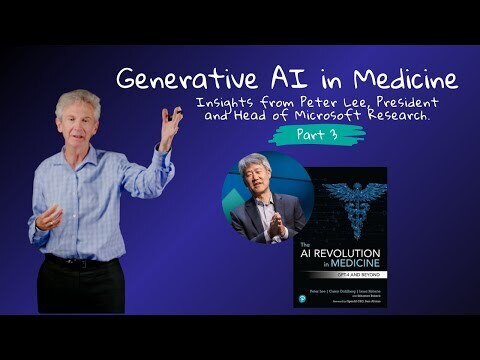
In a recent episode of his Code to Care series, Don Woodlock sat down with Dr. Peter Lee to unpack where agentic AI in healthcare is headed. They discussed:
- A concrete framework for what makes AI "agentic”
- Real systems already running in clinical settings
- And an insight about multi-agent collaboration that most coverage of this technology misses entirely
Whether you're evaluating agentic AI for your health system or trying to separate substance from hype, what follows is a practical breakdown: what the technology actually does, where it's producing real results, and what your organization needs in place before deploying it.
What Is Agentic AI? Four Components, One Framework
Traditional AI responds to prompts one at a time, with no memory between sessions, no permissions to act on external systems, and no ability to change anything in the real world.
Agentic AI is fundamentally different. These intelligent systems can observe, decide, and act, often autonomously, within healthcare settings.
Peter Lee breaks agentic AI into four components, a practical checklist for evaluating whether a system is genuinely agentic or just branded that way.
1. Memory
Early AI started every interaction from a blank slate. Agentic systems retain episodic context. The AI remembers this patient's penicillin allergy, the tumor board review three weeks ago, the radiologist's flagged finding from patient histories. Context persists across sessions, and the agent picks up where it left off.
2. Entitlements
What is the AI permitted to do? Can it query the electronic health record? Invoke a radiology model? Access lab results? Entitlements define the boundaries of an agent's autonomy, and in healthcare, those boundaries matter enormously.
For agents to act across clinical and operational systems, they need platforms that make healthcare data accessible without dozens of separate integrations.
Platforms like InterSystems IRIS, which combine database, integration, and analytics in a single layer, reduce the handoffs an agent must navigate to retrieve and act on patient data.
3. Actions
Agentic systems change the state of the world. They retrieve records, generate clinical notes, invoke other AI models for specialized analysis, schedule appointments, send reminders, and coordinate follow-ups.
Putting it simply: generative AI answers questions. Agentic AI does things.
4. Reasoning
This is the thread binding the other three together. An agentic system doesn't just execute a sequence of steps. It reasons toward a goal, adapting its chain of thought as new information arrives.
It works jointly with humans, holding more context in working memory than any individual clinician. Using technologies like natural language processing and machine learning, these intelligent agents can derive insights from vast datasets and automate complex tasks that would overwhelm a single person.
Peter Lee frames the moment with a baseball analogy: "We're in the middle innings of this tech revolution. And I think you're right that a centerpiece of this middle innings era is agentic AI."
The push to deploy is real, but the late innings remain uncertain. For a deeper look at how these components fit together in system design, see our guide to agentic AI architecture.
When AI Agents Debate Each Other: The MAI-DxO System
So how do AI agents “argue,” as mentioned in the introduction?
Here's what that looks like in the real world.
MAI-DxO is a multi-agent diagnostic system from Microsoft AI. Instead of asking one AI to weigh every factor in a complex diagnosis, the system assigns distinct roles to separate AI agents:
- A primary agent that interacts with patients and works toward a diagnosis
- A contrarian agent whose sole purpose is to disagree, constantly challenging the primary's reasoning, questioning assumptions, and pushing back on conclusions
- A cost agent that questions whether every proposed lab test or imaging study is justified from a resource perspective
These agents engage in a "chain of debate": structured disagreement that forces the diagnostic process through multiple rounds of challenge and refinement before converging on a conclusion. The system can analyze data from clinical notes, patient histories, and lab results simultaneously, processing context that no single clinician could hold in working memory.
In a collaboration with the New England Journal of Medicine, testing on a collection of extremely rare diagnostic cases, MAI-DxO reached a correct diagnosis over 80% of the time. The best-performing configuration hit 85.5%, more than four times better than very seasoned human clinicians working on the same cases, who averaged roughly 20% accuracy.
The accuracy matters. But the benefits don’t stop there. The AI agents are in a certain sense pushing each other to do better.
"These ideas of agentic computing aren't only to help facilitate human processes, they can kind of reinforce the intelligence of other AIs and on top of that reduce things like hallucination rates simply through challenging each other." - Dr. Peter Lee
Yes, the agents are helping automate processes that are prone to human error. But they’re also significantly reducing one of the biggest problems in AI which is hallucination. The contrarian agent doesn't need to be right. It needs to force the primary agent to defend its reasoning.
That process surfaces weaknesses in the chain of thought that would otherwise sail through unchecked.
That reframes the whole picture. The question most healthcare leaders ask about agentic AI is "what tasks can it automate?" The better question, and the one MAI-DxO answers, is "what happens when intelligent agents make each other smarter?"
From Diagnosis to Coordination: The Stanford Tumor Board
MAI-DxO proves agents can improve intelligence. The Stanford tumor board orchestrator tackles a different problem, one that may matter more for patient care on a daily basis: coordination across fragmented data and different systems.
Tumor boards are multidisciplinary meetings where oncologists, radiologists, surgeons, and pathologists review a specific patient's case and decide on treatment. Thousands of these happen every week across health systems worldwide, and each one requires care teams to pull together information scattered across multiple systems.
In a joint effort with Stanford Medicine, which sees 4,000 tumor board patients annually, Microsoft built an AI agent that participates in these meetings. The agent retrieves patient records, invokes specialized AI models for radiology and pathology analysis, surfaces published research matched to the patient's genetics, and generates notes for review.
It can provide real-time support to healthcare providers by handling complex tasks like deciphering intricate medical cases and coordinating cohesive care plans across multiple specialized departments.
Remember the MEAR components listed above? They’re all at play here. The agent:
- Retains patient context (Memory)
- Accesses EHRs, imaging systems, and research databases (Entitlements)
- Retrieves and generates outputs (Actions)
- And reasons toward a treatment recommendation with the clinical team (Reasoning).
Connecting those disparate data sources is exactly the interoperability challenge that platforms like InterSystems HealthShare were designed for. Oncology notes live in one system, radiology imaging in another, pathology reports in a third, published research in external databases.
HealthShare aggregates clinical data across multiple systems into a unified patient record, giving agentic systems (and clinicians) a single coherent view regardless of where the data originates.
This is the pattern that scales. Tumor boards require pulling together specialists, data, and decisions from across an entire health system. That same coordination challenge connects fragmented data so the right care teams can make the right decisions and show up in virtually every workflow in healthcare delivery.
Stanford Health Care's investment in agentic AI extends beyond tumor boards. Their AXIOM initiative uses a FHIR repository on InterSystems IRIS to power rapid clinical data retrieval which helps to reduce EHR query times from minutes to seconds for AI applications which includes augmented triage in emergency departments. The project won the 2025 InterSystems Impact Award for Healthcare Provider Innovation.
Watch More from the
Code to Care Series
A Practical Starting Point: AI as a Second Set of Eyes
Not every healthcare organization needs a multi-agent diagnostic system tomorrow.
Anthropic, the creators of Claude, wisely wrote in their guide to building agents: “When building applications with LLMs, we recommend finding the simplest solution possible, and only increasing complexity when needed.”
Thankfully, Dr. Lee offers a simpler starting point, one any clinician can try this week.
In his book The AI Revolution in Medicine, Lee recommends that doctors and nurses think of AI as "a second set of eyes."
The idea: develop your differential diagnosis, then present the case to an AI agent and ask two questions. Is there anything I've overlooked? Any errors in my reasoning?
"I think many doctors and nurses would be well served to do their own work but then think of an AI as an agent that can be a second set of eyes." - Dr. Peter Lee
Don highlights why this works even when the AI isn't perfect:
"It sort of expands the mind of the decision maker. Even levels of being a little bit wrong don't harm this use case because you're just asking for my mind to be a little bit expanded. ‘Anything else I should be considering?’" - Don Woodlock
The AI isn't making decisions. Rather, it's expanding the decision space. This approach helps reduce the cognitive load on healthcare professionals by offering a check against blind spots, without requiring the system to operate autonomously.
The adoption spectrum runs from this kind of validation to tumor board orchestration to autonomous multi-agent diagnosis. Healthcare organizations can enter wherever their data maturity and governance allow, and success depends on matching ambition to readiness.
The $1 Trillion Coordination Problem
The Stanford tumor board automates clinical coordination. The same pattern applies to healthcare's administrative machinery, and the numbers are hard to ignore.
US healthcare organizations spend over $1 trillion annually on administrative work. Not on patient care, on coordination.
Things like:
- Retrieving information from one system and reconciling it against another
- Assembling documentation
- Submitting through portals
- And tracking results
It drains clinician time and generates errors at every handoff. Healthcare professionals entered this industry to provide compassionate care to patients, not to reconcile data across portals.
Consider a typical prior authorization workflow. Today, a coordinator:
- Retrieves clinical notes from the EHR
- Checks payer-specific requirements in a separate portal
- Assembles the documentation packet
- Submits through yet another system
- And monitors the authorization status, often managing dozens of cases simultaneously
With an agentic system, the agent handles retrieval, assembly, compliance checks, and submission. The coordinator reviews the completed packet and manages exceptions. Work that took 45 minutes takes 10.
This isn't hypothetical. MUSC Health now completes 40% of prior authorizations autonomously using agentic AI, with no human involvement required.
InterSystems HealthShare supports these workflows through its Payer Services suite, which includes Prior Authorization Support, Coverage Requirements Discovery, and Documentation Templates, This gives organizations a standards-based foundation to layer agentic automation onto existing payer-provider integrations.
A Deloitte Center for Health Solutions survey of 100 US healthcare technology executives found that 85% plan to increase agentic AI investment over the next two to three years, with 98% expecting at least 10% cost savings through reduced administrative overhead and improved resource utilization.
Healthcare leaders expect agentic technology to deliver meaningful operational efficiency gains across hospitals and health systems.
The underlying challenge in these healthcare workflows is data fragmentation. Prior authorization, claims, and scheduling all depend on information scattered across EHRs, billing systems, and payer portals.
InterSystems IRIS for Health provides the integration and interoperability layer that lets agentic systems access and reconcile that data in real time, without requiring health systems to rip out and replace existing infrastructure.
Beyond admin, agentic systems are beginning to transform how healthcare organizations handle patient care after discharge. AI agents can monitor patients for symptoms, confirm medication adherence, schedule appointments for follow-ups, and flag concerns to care teams, providing real-time monitoring that catches problems before they escalate.
These proactive capabilities mean healthcare providers can offer clearer timelines and more reliable communication to patients, stabilizing back-end workflows while improving care quality and the overall patient experience. (For a detailed case study of AI-driven workflow redesign in a clinical setting, see our article on healthcare automation.)
Every minute spent reconciling data across portals is a minute not spent with patients. Agentic systems handle the coordination so care teams can focus on delivering compassionate care.
What Agentic AI Needs: Data, Standards, and Governance
Everything described above depends on one thing: data. The MEAR framework makes the dependency explicit. Memory requires clinical data to remember. Entitlements require systems that grant access. Actions require APIs that respond. Reasoning requires clean, structured inputs.
In most health systems, patient data sits across EHRs, billing platforms, payer portals, faxes, and departmental digital tools in different formats, with different completeness and different update cycles. The vast majority of healthcare data remains unused, locked in formats that existing systems cannot process at the scale agentic AI applications require. Healthcare systems face significant challenges due to this fragmentation and the interoperability issues it creates.
Three foundations matter for healthcare organizations looking to deploy agentic systems.
Interoperable Data
Healthcare interoperability standards like FHIR and HL7 are the rails agentic systems run on. InterSystems HealthShare Health Connect, available as a cloud-managed service, handles the protocol translation and message routing that let intelligent agents communicate across clinical systems, supporting HL7, FHIR, X12, DICOM, and other healthcare standards without requiring custom point-to-point integrations. This modular architecture means health systems can connect different systems incrementally rather than attempting a full rip-and-replace.
Data harmonization without centralization
Rather than centralizing data into a warehouse (a multi-year project most health systems cannot afford), a Smart Data Fabric approach harmonizes data in place, giving agents a unified view without requiring data movement.
This is the approach InterSystems has built into the IRIS platform, connecting and harmonizing fragmented data across disparate sources in real time so agentic systems can derive insights from the full picture.
Governance and human oversight
These are clear rules for what agents can do independently, when they must escalate, and how every action gets logged.
Agentic systems will make errors. That's a given.
Regulatory compliance requirements make the architecture's job doubly important: catch those errors before they reach patients. Multi-agent debate, human-in-the-loop checkpoints, transparency with patients about how AI participates in their care, and audit trails aren't optional features. They're the reason the technology works.
The barriers to adoption are easing. The Deloitte survey found that 40% of healthcare executives say technical talent shortages were previously a top obstacle, are no longer seen as a major challenge. Resistance to change and data quality concerns are also declining as blockers, with 38% and 32% of leaders reporting improvement in those areas, respectively.
Healthcare leaders must still focus on building strong data foundations and governance structures, but the path is clearer than it was even a year ago.
One thing worth knowing: agents surface data-quality problems earlier and more bluntly than human workflows do. When an agent can't complete a task because records contain conflicting information, that's a diagnostic signal, not a technology failure. It's the system telling you where the foundation needs work.
What Comes Next
As agentic AI in healthcare continues to mature, Peter Lee's honesty about the future is itself a reason to pay attention:
"That doesn't mean that in the late innings agentic AI will be a big thing. It could be. It's hard to predict. But for sure there's going to be a tremendous push today to deploy agent-based systems out in the world." - Dr. Peter Lee
That kind of measured assessment, from the President of Microsoft Research, is worth more than a dozen hype cycles. The push to deploy is real. Where it leads is genuinely unclear.
For healthcare leaders evaluating agentic AI today, here are three starting points:
Identify the coordination bottlenecks
Where do your care teams spend the most time retrieving, reconciling, and sequencing information across systems? Those high-volume, coordination-heavy healthcare workflows are where agentic AI delivers the fastest returns.
Invest in data readiness before autonomy
Intelligent agents need interoperable, structured healthcare data to operate autonomously. ( Getting data AI-ready is a practical starting point.) The healthcare organizations that build that foundation now will be positioned to deploy agentic systems as the technology matures.
Start with human-in-the-loop
Begin with agentic systems that support clinicians and staff, then expand autonomy as governance structures mature and confidence builds. The successful integration of agentic AI requires a strong foundation of data readiness, governance, and change management.
The healthcare organizations that benefit most won't be the ones that deploy the most agents. They'll be the ones where AI systems and clinicians make each other better, transforming healthcare from reactive coordination into proactive, intelligent care delivery.
Frequently Asked Questions
Stanford Health Care also developed AXIOM, which uses InterSystems IRIS to accelerate EHR data retrieval for AI-driven emergency triage and clinical decision support — winning the 2025 InterSystems Impact Award for Healthcare Provider Innovation.
In production, MUSC Health uses agentic AI to complete 40% of prior authorizations autonomously. Other real-world applications include post-discharge patient monitoring, ambient clinical documentation, and real-time scheduling optimization in hospitals.
This approach works even with imperfect AI because the goal is expanding the decision space and reducing cognitive load, not replacing the clinician's judgment. It's a practical entry point for any healthcare provider looking to integrate intelligent systems into patient care.
Healthcare organizations spend over $1 trillion annually on administrative work, much of it coordination that agentic systems can handle, improving operational efficiency while freeing care teams to focus on patients.
Deploy with human-in-the-loop governance and expand autonomy gradually. Success depends on matching ambition to readiness, and healthcare leaders should focus on building strong data foundations before pursuing full autonomy.