
















Skip to content
Products
By Type
By Industry
Applications
A suite of applications built on InterSystems IRIS data platform and optimized to address industry specific challenges.
A FHIR®-enabled care management software solution that allows the entire care team to create and share comprehensive care plans.
A cloud-based, on-demand service delivering near real-time, secure access to patient data from across the nation.
Analytics solution that provides real-time care insights and in-depth analysis for clinical, business, and population health management.
A next-generation enterprise master person index – an automated, easily integrated solution for identity resolution.
A reimagined EHR with built-in GenAI at its core

Revenue Cycle Management
Medication Management
Helps clinicians, care managers, and care teams strengthen coordination, enhance continuity of care, and improve patient engagement in under-served rural areas.
Enables health systems, independent providers, health plans, HIEs, governments and software developers to create a digital front door.
Collects, consolidates, and publishes information about healthcare providers' relationships to patients, health plans, and one another.
A powerful, flexible EHR that supports leading healthcare interoperability standards & profiles.

TrakCare Assistant
Revenue Cycle Management
Medication Management
Enterprise solution supports any clinical lab service, public or private, independent to extensive national laboratory systems.
Low Code Platforms
A suite of low code platforms built on InterSystems IRIS and optimized to address industry-specific challenges.
An aggregated, normalized and deduplicated patient record created from patient data across multiple sources.
A high-availability, high-performance integration engine created specifically for healthcare.
A cloud-based data pipeline and management solution combining FHIR with an out-of-the-box transformation to the CDM and OMOP repository.
One integration that standardizes data exchange between Epic Payer Platform and your clinical and administrative applications.
Interoperability solutions designed to help U.S. health insurers address CMS-0057 and CMS-9115.
Platforms & Components
Versatile foundation supporting a range of solutions, with built-in APIs for integration.
Rapidly access & use FHIR data from diverse sources without the need to create your own FHIR computing infrastructure.
A high-performance data platform designed to make it easy to build applications that support mission-critical processes.
Fully managed cloud-native SaaS offerings that provide customers the fastest time to value for InterSystems data management software.
A digital health data platform that provides the building blocks needed to work with any healthcare data standard, including FHIR.
An AI-enabled supply chain decision intelligence platform that predicts disruptions before they occur, and optimally handles when they do.
Healthcare
InterSystems HL7 FHIR-based technology and solutions power success for organizations across the entire healthcare ecosystem.
A cloud-based, on-demand service delivering near real-time, secure access to patient data from across the nation.
A suite of solutions that work together to capture information, share it in a meaningful way, aid understanding, and drive transformative action.
Analytics solution that provides real-time care insights and in-depth analysis for clinical, business, and population health management.
Rapidly access & use FHIR data from diverse sources without the need to create your own FHIR computing infrastructure.
A high-availability, high-performance integration engine created specifically for healthcare.
A reimagined EHR with built-in GenAI at its core

Revenue Cycle Management
Medication Management
A digital health data platform that provides the building blocks needed to work with any healthcare data standard, including FHIR.
A cloud-based data pipeline and management solution combining FHIR with an out-of-the-box transformation to the CDM and OMOP repository.
One integration that standardizes data exchange between Epic Payer Platform and your clinical and administrative applications.
Interoperability solutions designed to help U.S. health insurers address CMS-0057 and CMS-9115.
Helps clinicians, care managers, and care teams strengthen coordination, enhance continuity of care, and improve patient engagement in under-served rural areas.
A powerful, flexible EHR that supports leading healthcare interoperability standards & profiles.

TrakCare Assistant
Revenue Cycle Management
Medication Management
Enterprise solution supports any clinical lab service, public or private, independent to extensive national laboratory systems.
Financial Services
Enabling firms to transform at scale, so they can increase customer satisfaction, adopt generative AI, maintain compliance, grow revenue, and optimize efficiency.
A high-performance data platform designed to make it easy to build applications that support mission-critical processes.
The fastest way for financial services firms to break down silos and transform disparate data into a single unified resource of actionable information.
Launch new funds, accelerate AI initiatives, automate reporting with a self-service solution tailor-made for asset management firms.
Supply Chain
Empowering organizations with real-time supply chain visibility and the ability to make optimized, real-time, AI-driven decisions.
An AI-enabled supply chain decision intelligence platform that predicts disruptions before they occur, and optimally handles when they do.
A data gateway that speeds and simplifies data access for supply chain applications and practitioners.
Knowledge Hub
Developer Websites
New to InterSystems? Start here, this is your gateway to developer sites, tutorials and more.
Connect, grow, share. The developer community is full of resources, news, and events and a community of people to connect with.
Everything you need to know about our products and more.
Develop. Learn. Share. Network. All with InterSystems Global Masters program where you can join an engaged community of developers.
Experience first hand the community’s dedication to the evolution of our technology with applications.
Education
Get to know InterSystems products and technologies your way, with self-paced online materials and classroom courses.
Online learning presents self-paced materials to help you build and support your organization's most critical applications.
In-person courses maximize learning in a distraction-free environment with face-to-face engagement.
InterSystems proudly supports the free use of InterSystems products for university and college coursework.
View the full list of course offerings and our current course schedule.
Certification
Offers industry-standard exams, flexible testing options, certification badges, and career advancement opportunities demonstrating expertise in InterSystems technologies.
InterSystems Learning Services offers industry-standard certification exams that allow you to prove your mastery of our technology.
Digital credentials that represent the varying levels of achievement you can earn with InterSystems.
Everything you need to know about preparing for, scheduling, and taking InterSystems Exams.
Retake Policies & Support, Beta Exams and more.
Answers to common questions regarding exams, including exam preparation, practice exams, retaking exams, and certifications.
InterSystems Blogs
Explore InterSystems blogs featuring expert insights, industry trends, technology innovations, data management strategies, and thought leadership.
Healthcare industry experts talk about pressing challenges, issues, and trends at the intersection of healthcare and technology.
Addressing various business, data, and technology-related issues for the line of business.
Partners
Partner Programs
Our partners ensure that organizations around the globe are already ready for tomorrow’s opportunities.
Bring together people, processes and technology to deliver solutions that solve complex customer challenges.
Combine your expertise with our proven data, analytics and interoperability capabilities to deliver optimal solutions.
Specialists whose services and guidance ensure consistent, effective delivery of InterSystems technology.
Provide complementary tools and platforms that strengthen and expand our technologies' capabilities.
InterSystems powers data-driven digital startups across healthcare, financial services, and supply chain.
Cloud Partners
InterSystems works with the world's leading cloud providers to give customers the freedom to deploy our technology where it delivers the most value.
The speed, scale, and capabilities of InterSystems and AWS can streamline operations, improve access to data and power breakthrough applications.
InterSystems IRIS and InterSystems IRIS for Health Data Platforms are Preferred Solutions on Azure Marketplace.
InterSystems and Google Cloud empower you to quickly build new apps or modernize existing ones to increase agility and reap the benefits of the multicloud.
InterSystems works with the world’s leading cloud providers - including Amazon Web Services (AWS), Microsoft Azure, Google Cloud, TenCent and Alibaba
Company
About Us
Our technologies provide the connective tissue that transforms disparate data into a single, complete view, enabling better outcomes.
News
News and resources for media including press releases, media kits, tools and more.
The latest news and coverage from our corporate headquarters in Boston, MA.
Core information about InterSystems, our background, our products and technologies, and more.
Please contact Corporate Affairs & Communications regarding media inquiries.
Events
Check out conferences and events we're hosting and attending, and view on-demand content for anything you missed.
Browse our upcoming conference and event schedule to see where we'll be and what we'll be covering.
View our library of on-demand content, including keynote speeches from InterSystems READY, webinars and live event footage.
Watch keynote presentations from InterSystems READY 2026.
Support
Product Support
We provide expert technical assistance to customers 24 hours a day, every day, with support advisors in 15 countries.
Read about support alerts, critical issues, fixes, and product releases.
Access current and previous versions and related notes for InterSystems products.
Contact the WRC for Immediate Help
Documentation
Detailed technical information for InterSystems products, technologies, solutions, and more.
Products
By Type
By Industry
Applications
A suite of applications built on InterSystems IRIS data platform and optimized to address industry specific challenges.
A FHIR®-enabled care management software solution that allows the entire care team to create and share comprehensive care plans.
A cloud-based, on-demand service delivering near real-time, secure access to patient data from across the nation.
Analytics solution that provides real-time care insights and in-depth analysis for clinical, business, and population health management.
A next-generation enterprise master person index – an automated, easily integrated solution for identity resolution.
A reimagined EHR with built-in GenAI at its core

Revenue Cycle Management
Medication Management
Helps clinicians, care managers, and care teams strengthen coordination, enhance continuity of care, and improve patient engagement in under-served rural areas.
Enables health systems, independent providers, health plans, HIEs, governments and software developers to create a digital front door.
Collects, consolidates, and publishes information about healthcare providers' relationships to patients, health plans, and one another.
A powerful, flexible EHR that supports leading healthcare interoperability standards & profiles.

TrakCare Assistant
Revenue Cycle Management
Medication Management
Enterprise solution supports any clinical lab service, public or private, independent to extensive national laboratory systems.
Low Code Platforms
A suite of low code platforms built on InterSystems IRIS and optimized to address industry-specific challenges.
An aggregated, normalized and deduplicated patient record created from patient data across multiple sources.
A high-availability, high-performance integration engine created specifically for healthcare.
A cloud-based data pipeline and management solution combining FHIR with an out-of-the-box transformation to the CDM and OMOP repository.
One integration that standardizes data exchange between Epic Payer Platform and your clinical and administrative applications.
Interoperability solutions designed to help U.S. health insurers address CMS-0057 and CMS-9115.
Platforms & Components
Versatile foundation supporting a range of solutions, with built-in APIs for integration.
Rapidly access & use FHIR data from diverse sources without the need to create your own FHIR computing infrastructure.
A high-performance data platform designed to make it easy to build applications that support mission-critical processes.
Fully managed cloud-native SaaS offerings that provide customers the fastest time to value for InterSystems data management software.
A digital health data platform that provides the building blocks needed to work with any healthcare data standard, including FHIR.
An AI-enabled supply chain decision intelligence platform that predicts disruptions before they occur, and optimally handles when they do.
Healthcare
InterSystems HL7 FHIR-based technology and solutions power success for organizations across the entire healthcare ecosystem.
A cloud-based, on-demand service delivering near real-time, secure access to patient data from across the nation.
A suite of solutions that work together to capture information, share it in a meaningful way, aid understanding, and drive transformative action.
Analytics solution that provides real-time care insights and in-depth analysis for clinical, business, and population health management.
Rapidly access & use FHIR data from diverse sources without the need to create your own FHIR computing infrastructure.
A high-availability, high-performance integration engine created specifically for healthcare.
A reimagined EHR with built-in GenAI at its core

Revenue Cycle Management
Medication Management
A digital health data platform that provides the building blocks needed to work with any healthcare data standard, including FHIR.
A cloud-based data pipeline and management solution combining FHIR with an out-of-the-box transformation to the CDM and OMOP repository.
One integration that standardizes data exchange between Epic Payer Platform and your clinical and administrative applications.
Interoperability solutions designed to help U.S. health insurers address CMS-0057 and CMS-9115.
Helps clinicians, care managers, and care teams strengthen coordination, enhance continuity of care, and improve patient engagement in under-served rural areas.
A powerful, flexible EHR that supports leading healthcare interoperability standards & profiles.

TrakCare Assistant
Revenue Cycle Management
Medication Management
Enterprise solution supports any clinical lab service, public or private, independent to extensive national laboratory systems.
Financial Services
Enabling firms to transform at scale, so they can increase customer satisfaction, adopt generative AI, maintain compliance, grow revenue, and optimize efficiency.
A high-performance data platform designed to make it easy to build applications that support mission-critical processes.
The fastest way for financial services firms to break down silos and transform disparate data into a single unified resource of actionable information.
Launch new funds, accelerate AI initiatives, automate reporting with a self-service solution tailor-made for asset management firms.
Supply Chain
Empowering organizations with real-time supply chain visibility and the ability to make optimized, real-time, AI-driven decisions.
An AI-enabled supply chain decision intelligence platform that predicts disruptions before they occur, and optimally handles when they do.
A data gateway that speeds and simplifies data access for supply chain applications and practitioners.
Knowledge Hub
Developer Websites
New to InterSystems? Start here, this is your gateway to developer sites, tutorials and more.
Connect, grow, share. The developer community is full of resources, news, and events and a community of people to connect with.
Everything you need to know about our products and more.
Develop. Learn. Share. Network. All with InterSystems Global Masters program where you can join an engaged community of developers.
Experience first hand the community’s dedication to the evolution of our technology with applications.
Education
Get to know InterSystems products and technologies your way, with self-paced online materials and classroom courses.
Online learning presents self-paced materials to help you build and support your organization's most critical applications.
In-person courses maximize learning in a distraction-free environment with face-to-face engagement.
InterSystems proudly supports the free use of InterSystems products for university and college coursework.
View the full list of course offerings and our current course schedule.
Certification
Offers industry-standard exams, flexible testing options, certification badges, and career advancement opportunities demonstrating expertise in InterSystems technologies.
InterSystems Learning Services offers industry-standard certification exams that allow you to prove your mastery of our technology.
Digital credentials that represent the varying levels of achievement you can earn with InterSystems.
Everything you need to know about preparing for, scheduling, and taking InterSystems Exams.
Retake Policies & Support, Beta Exams and more.
Answers to common questions regarding exams, including exam preparation, practice exams, retaking exams, and certifications.
InterSystems Blogs
Explore InterSystems blogs featuring expert insights, industry trends, technology innovations, data management strategies, and thought leadership.
Healthcare industry experts talk about pressing challenges, issues, and trends at the intersection of healthcare and technology.
Addressing various business, data, and technology-related issues for the line of business.
Partners
Partner Programs
Our partners ensure that organizations around the globe are already ready for tomorrow’s opportunities.
Bring together people, processes and technology to deliver solutions that solve complex customer challenges.
Combine your expertise with our proven data, analytics and interoperability capabilities to deliver optimal solutions.
Specialists whose services and guidance ensure consistent, effective delivery of InterSystems technology.
Provide complementary tools and platforms that strengthen and expand our technologies' capabilities.
InterSystems powers data-driven digital startups across healthcare, financial services, and supply chain.
Cloud Partners
InterSystems works with the world's leading cloud providers to give customers the freedom to deploy our technology where it delivers the most value.
The speed, scale, and capabilities of InterSystems and AWS can streamline operations, improve access to data and power breakthrough applications.
InterSystems IRIS and InterSystems IRIS for Health Data Platforms are Preferred Solutions on Azure Marketplace.
InterSystems and Google Cloud empower you to quickly build new apps or modernize existing ones to increase agility and reap the benefits of the multicloud.
InterSystems works with the world’s leading cloud providers - including Amazon Web Services (AWS), Microsoft Azure, Google Cloud, TenCent and Alibaba
Company
About Us
Our technologies provide the connective tissue that transforms disparate data into a single, complete view, enabling better outcomes.
News
News and resources for media including press releases, media kits, tools and more.
The latest news and coverage from our corporate headquarters in Boston, MA.
Core information about InterSystems, our background, our products and technologies, and more.
Please contact Corporate Affairs & Communications regarding media inquiries.
Events
Check out conferences and events we're hosting and attending, and view on-demand content for anything you missed.
Browse our upcoming conference and event schedule to see where we'll be and what we'll be covering.
View our library of on-demand content, including keynote speeches from InterSystems READY, webinars and live event footage.
Watch keynote presentations from InterSystems READY 2026.
Support
Product Support
We provide expert technical assistance to customers 24 hours a day, every day, with support advisors in 15 countries.
Read about support alerts, critical issues, fixes, and product releases.
Access current and previous versions and related notes for InterSystems products.
Contact the WRC for Immediate Help
Documentation
Detailed technical information for InterSystems products, technologies, solutions, and more.
Search to learn about InterSystems products and solutions, career opportunities, and more.
Abstract data representation

Agentic AI Architecture: A Practical Guide to Building Smarter AI Systems

Based on insights from Don Woodlock, President of InterSystems, from his Code to Care YouTube series.

What Is Agentic AI Architecture?

Agentic AI architecture is a system design that organizes multiple specialized AI agents with each handling a distinct piece of a larger task, so the combined result outperforms any single model working alone.

"Essentially think of these LLMs as agents, and each agent is doing one piece of this task," explains Don Woodlock, President of InterSystems, in his Code to Care series.

conductor.png

Unlike traditional AI, which responds to a single prompt with a single output, agentic AI systems can plan, use tools, retain memory, and make autonomous decisions across multiple steps.

Instead of asking one model to do everything, you assign intelligent agents to specialized roles. One drafts. Another critiques. A third revises. Some aren't even language models; they're tools like search engines, APIs, and calculators. An orchestrator coordinates them all toward a shared goal.

Agentic AI architecture diagram

What made this practical? Large language models crossed a reliability threshold. Earlier models couldn't be trusted with autonomous subtasks; they'd drift off-topic or fabricate constraints. Modern AI agents follow complex instructions well enough that each can be assigned a specialized role within a larger system, perceive its environment, and take action without human intervention at every step.
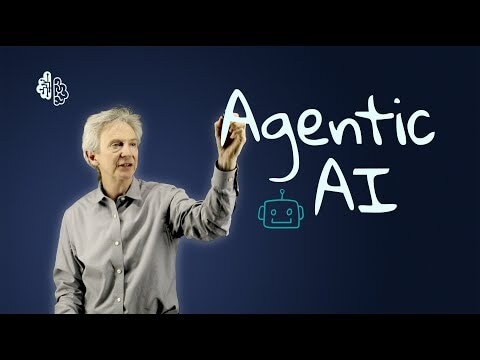
Using Agentic AI to create smarter solutions with multiple LLMs (step-by-step process)

The Problem Agentic Architecture Solves

Large language models generate output one token at a time, moving only forward. There's no revision built into a single model call.

Think about how you'd actually build a marketing plan. You'd start with an outline. Write a draft. Review it. Get feedback. Revise. Maybe do a dry run, then produce a final version. Multiple passes, each improving the last.

An LLM does all of that in a single forward pass. No outline. No critique. No revision. The output is whatever the model predicted word by word, with no chance to step back and reconsider.

Agentic architecture fills this gap. By chaining agents together with each responsible for a different stage, you give AI systems the ability to draft, evaluate, and refine complex workflows that a single model can't handle alone.

Chain-of-thought prompting research ( Wei et al., 2022; Kojima et al., 2022) demonstrated that prompting LLMs to work through intermediate reasoning steps significantly improved accuracy on complex tasks. Agentic architecture extends that principle from a single prompt technique to a full system design: instead of asking one model to pause and think, you build a team of agents that inherently operates in stages.

Agentic AI architecture diagram

Three Mental Leaps from LLMs to Agentic AI

Leap 1: Think of LLMs as Agents

Start with what Don calls "compound AI", stringing multiple LLMs together instead of relying on one. The simplest version uses three models in sequence:

  1. Draft Agent: generates initial output
  2. Critique Agent: evaluates the draft against the original requirements
  3. Final Agent: revises based on the critique

"This actually works. This will give you a much better result. You can try it yourself actually with ChatGPT." - Don Woodlock

The key shift: stop thinking of each LLM call as "the AI." Start thinking of each as an agent with a role, a drafter, a critic, a finisher. You can use the same model for all three or mix different models for variety and perspective. The compound result outperforms any single call.

Leap 2: Not All Agents Are LLMs

Once you think in terms of agents, the next realization: not every agent needs to be a language model.

"Some of these agents could be tools, like do a Google search, call an API to schedule an appointment, a calculator API to do some math." - Don Woodlock

In Don's example, a "data request agent" identifies what statistics would strengthen a marketing plan. A separate agent runs web searches to find them. The search agent is an API call. But within the system, it fills the same role: receive a task, execute it, return a result.

This is what separates agentic systems from prompt chains. The architecture accommodates any type of processing (e.g., language models, search engines, databases, calculators, or external APIs) all coordinated toward a single goal.

Leap 3: Dynamic Orchestration

The final leap: the workflow doesn't have to be hardcoded.

Instead of defining a fixed six-step pipeline, you give an orchestrator agent a goal, a set of available agents, and general instructions. It decides the sequence. It might loop back for additional research. It might skip a step that isn't needed. It adapts.

Think of the orchestrator as a detective. A detective doesn't follow a checklist, instead they pursue a goal (solve the case) and let each piece of evidence shape what they investigate next. If a lead goes cold, they loop back. If a witness opens a new angle, they follow it. The orchestrator works the same way: goal first, sequence second.

This is what makes agentic architecture different from traditional automation. The system isn't following a script. It's pursuing a goal.

Agentic AI architecture diagram

Core Components of an Agentic System

Every agentic system, regardless of complexity, shares four core modules plus an orchestration layer that ties them together.

Agentic AI architecture diagram

Perception

The perception module acts as the system's sensory layer, gathering real-time data from APIs, databases, sensor feeds, or user interfaces and processing that data into usable representations. This is where natural language processing parses text inputs, computer vision interprets images, and data connectors pull structured records from enterprise systems. The perception layer sets the ceiling for everything downstream. An agent's output is only as good as the data it can access.

In healthcare, organizations using unified data platforms like InterSystems HealthShare, aggregate records across multiple EHR vendors through standards like FHIR® and HL7®, give their agents a far more complete data foundation than those pulling from fragmented silos.

Reasoning

The cognitive module interprets inputs from the perception layer in light of the agent's current goals. This is where machine learning models, chain-of-thought logic, and planning algorithms operate.

The reasoning capabilities of large language models have made deliberative agents practical. They can weigh options, set sub-goals, and adjust plans mid-task.

But reasoning is also where things go wrong. A model that misinterprets data or sets the wrong sub-goal cascades errors downstream.

Memory

Memory systems give agents context beyond the current prompt. Short-term memory tracks active session context and intermediate results. What has the draft agent produced so far? What data has already been retrieved?

Long-term memory stores historical outcomes, user preferences, and accumulated knowledge, allowing the system to improve over time. Agents that maintain a record of past interactions and environmental states can perform long-horizon reasoning, which connects today's task to lessons learned from previous ones.

Context management across agents is one of the harder engineering problems in multi-agent setups; each agent's knowledge needs to be scoped correctly so it has what it needs without being overwhelmed by irrelevant information.

Action

The action module executes decisions: generating text, calling an API, updating a database record, or handing off to the next agent. In Don's framework, the Draft, Critique, and Final agents each perform different actions in service of the same goal.

Actions can also trigger downstream processes in external software systems like scheduling appointments, filing tickets, updating CRM records, or pushing data to analytics pipelines. The action layer is where agentic AI connects to the real world.

ai-agents-steps.png

Orchestration and Feedback

The orchestration layer coordinates the flow of data and control between all other modules, deciding which agent runs next and what information it receives.

Beneath this sits the feedback loop, which is the mechanism that allows the system to evaluate its own progress, identify logic errors, and adjust strategies in real-time based on environmental feedback. Agentic systems improve over time through reinforcement learning loops as they ingest more data and refine agent behavior with each iteration.

Agent Design Patterns

Agentic systems can be analyzed at two levels: how individual agents are designed, and how multiple agents are organized into a system.

Individual Agent Design

The way a single agent processes information and makes decisions shapes what it can handle:

Pattern

How It Works

Best For

Reactive
  • Responds to immediate stimuli without drawing on memory or prediction
  • A model-based reflex agent maps percepts directly to actions
Simple, fast tasks: alert routing, threshold-based triggers
Deliberative
  • Reasons, plans, and uses internal models of the world to decide
  • Slower but far more capable
Complex problems requiring multi-step planning: research, analysis
Cognitive
Mimics human-like thinking; including reasoning, learning, and autonomous decision-making with both short-term and long-term memory.
Tasks requiring adaptation: personalized recommendations, iterative content creation

Most modern AI agents are deliberative or cognitive. The reasoning capabilities of large language models make these patterns practical in ways that weren't possible five years ago.

System-Level Architecture

How agents are organized determines how they collaborate and who makes decisions:

Pattern

Structure

Best For

Trade off

Single-agent
  • One agent making centralized decisions with tools and a system prompt
  • Single agent systems handle the full task alone
Well-defined tasks: support lookups, document summarization, code review
  • Simple to build and debug
  • Limited by one agent's capabilities
Pipeline (Vertical)
  • A leader agent oversees subtasks, directing multiple specialized agents in sequence
  • Hierarchical AI agents report results back up the chain
Sequential workflows: content creation, data processing, report generation
  • Predictable and testable
  • Inflexible if requirements shift mid-task
Peer (Horizontal)
  • Agents work as equals in a decentralized system, there is no single leader
  • Agents operate independently and negotiate outcomes
Creative tasks: brainstorming, red-team/blue-team evaluation, interdisciplinary analysis
  • Diverse perspectives
  • Harder to converge on a single answer
Hybrid
  • Combines structured leadership with collaborative flexibility, this balances leadership roles between structured and creative demands
  • Leadership shifts based on task phase
Complex projects mixing structured execution and open-ended exploration
  • Most capable
  • Most complex to build and debug
Agentic AI architecture diagram

Don's "Draft-Critique-Revise" example is a pipeline where the workflow follows a predetermined sequence. His orchestrator example is a hybrid in which the system adapts based on what each step produces.

The ideal agent architecture depends on the requirements of the application. Start with a single-agent architecture for well-defined tasks. Graduate to multi-agent architectures only when task complexity demands it for things like specialization, parallel execution, or cross-domain coordination.

How Agents Collaborate

In multi-agent architectures, the challenge is getting individual agents to work together.

Multi-agent collaboration requires solving three challenges: communication, coordination, and resource sharing.

Communication

Agents communicate through structured message passing. One agent's output becomes another's input. Communication protocols define the format, routing, and priority of these messages.

In vertical systems, agents reporting to a leader agent follow a hub-and-spoke pattern. In horizontal systems, agents negotiate peer-to-peer.

Standards like Model Context Protocol (MCP) were invented to standardize how agents connect to tools and data sources, reducing the integration burden for agent development teams.

Parallel Execution

One of the key features of multi-agent systems over single-agent architectures is parallel processing. Different agents can handle separate subtasks simultaneously (e.g., one researches while another drafts while a third queries a database).

This enables AI agents to solve complex problems faster than a single model working sequentially. But parallel execution introduces synchronization challenges: agents need to merge their results coherently without contradictions or duplication.

Coordination

The main challenge in multi-agent architectures is coordination. Without robust mechanisms for synchronization, agents share resources inefficiently, duplicate work, or produce conflicting outputs.

This is especially acute in dynamic environments where task requirements shift mid-workflow. Performance monitoring at the system level (i.e., tracking which agents are bottlenecked, which are idle, and where errors accumulate) is essential for maintaining AI performance as the system scales.

Multi-agent systems are well suited for domains that require collaboration across diverse skill sets like compliance review, market research, workflow optimization, or cross-functional projects where analytical, creative, and operational expertise need to converge on a single deliverable.

When Agentic Architecture Makes Sense

Agentic AI is not always the right choice. Summarizing a document, classifying a support ticket, or translating text works fine with a single LLM call. Adding agents to those tasks creates overhead without meaningful improvement.

Agentic AI architecture diagram

Agentic architecture earns its complexity when:

  • Tasks require multiple steps: research, analysis, and synthesis in sequence
  • External data is essential: the system needs to query databases, APIs, or live sources mid-workflow
  • Self-correction improves outcomes: a critique loop measurably raises output quality
  • Coordination across systems is needed: agents must pull from and push to different platforms

If the task has a single input, a single output, and no intermediate decisions, a well-crafted prompt will outperform an agentic system at a fraction of the cost and latency.

Enterprise Value

Agentic AI systems excel at solving open-ended problems that require autonomous decision-making and complex multi-step workflow management. In enterprise environments, this translates to measurable impact.

Organizations report business process acceleration of 30% to 50% when agentic systems handle task automation for operational workflows like compliance checks, data reconciliation, and customer onboarding.

In practice, this means agents tailored to specific business functions. As Don describes, you might build "a model that checks against your organizational policies or your brand", turning compliance review or brand governance from a manual bottleneck into an automated step in an agent-driven workflow.

Agentic AI can automate knowledge-intensive tasks that traditional AI models can't handle like analyzing unstructured data across multiple sources, making judgment calls, and adapting to exceptions.

These systems function around the clock and scale to handle sudden spikes in data or inquiries without increasing headcount. Offloading repetitive cognitive work frees employees to focus on high-value strategy and creative innovation.

In healthcare, agentic AI enhances both operational efficiency and clinical decision-making. Agents that analyze medical images, cross-reference patient histories, and learn from new cases can improve diagnostic accuracy over time.

The integration of agentic AI into existing enterprise systems strengthens competitive advantages acros sectors.

Platforms like InterSystems IRIS Data Platform provide the interoperability backbone these agents need in healthcare and beyond, connecting systems through standards like FHIR and HL7 regardless of vendor.

Supply chain operations benefit similarly. Agents that sense demand shifts and adjust fulfillment in real time need to run analytics on live transactional data, not on yesterday's warehouse extract. InterSystems IRIS supports this natively through translytical processing, running both transactional and analytical workloads on the same data without ETL delays.

Building Agentic Systems: Frameworks and Platforms

Implementing agentic AI systems requires careful selection of agent types, tools, and agentic AI frameworks that align with specific AI capabilities and business objectives. The ecosystem has matured rapidly.

Agent frameworks handle agent logic, coordination, and tool use:

Framework

Maintained By

Approach

LangGraph
LangChain
Graph-based workflows. Agents as nodes, transitions as edges. Maximum flexibility, steeper learning curve.
CrewAI
Open source (AI Fund)
Role-based "crews". Assign agents roles, goals, and backstories. Fastest path to multi-agent prototypes.
Microsoft Agent Framework
Microsoft
Unified framework (merging AutoGen + Semantic Kernel). Deep Azure integration. Enterprise-focused.
Google ADK
Google
Code-first toolkit with built-in tools, Model Context Protocol support, and visual debugging UI. Integrates with Vertex AI.

These frameworks handle agent logic and coordination. But agents also need access to enterprise data that's spread across databases, interoperability engines, and real-time analytics. Platforms like InterSystems IRIS provide the data infrastructure layer that agents query and act upon, enabling developers to build agentic AI capabilities into existing software systems.

Selecting a practical framework is essential for building maintainable, scalable systems. The right choice depends on your team's expertise, your cloud environment, and whether you need pre-built agent patterns or maximum customization.

Start here: Pick one framework and build the draft-critique-revise pattern from Leap 1. Use a single LLM for all three agents. Get it working. Then expand.

Design Considerations

Building agentic systems introduces tradeoffs that single-model approaches avoid. Organizations must navigate significant technical complexity to ensure successful execution.

  • Latency compounds. Each agent adds a round-trip. A three-agent pipeline takes roughly 3x the latency of a single call. Design for acceptable response times before adding agents.
  • Errors propagate. A flawed output from the Draft Agent feeds into the Critique Agent, which may not catch it. Build validation checks at each handoff so they are not just at the end.
  • Costs scale. More agents means more API calls means higher costs. Measure cost-per-task and compare against the quality gain. Sometimes a well-engineered single prompt is cheaper and good enough.
  • Debugging is harder. When a five-agent system produces a bad result, you need to trace which agent went wrong. Structured logging at every agent boundary is essential.
  • Diminishing returns hit fast. Adding a fourth, fifth, sixth agent rarely helps as much as improving the first three.

Scalability

Scalability is one of the biggest challenges in agentic AI architecture, particularly when transitioning from single-agent to multi-agent systems. Agentic AI systems require robust infrastructure to handle higher workloads and ensure seamless communication among agents. What works for a three-agent prototype may collapse at twenty agents. Message queues overflow, context windows fill up, and coordination overhead become the bottleneck.

Testing

Testing agentic AI requires both synthetic and real-world datasets to ensure robustness and reliability. Synthetic data lets you stress-test edge cases and failure modes in controlled conditions. Real-world data reveals the messy, unpredictable inputs the system will actually encounter. Test each agent in isolation first, then test the full system end-to-end. The interactions between agents surface problems that unit-level testing misses.

Iteration

The process of designing an agentic AI architecture is iterative. Architectures should be periodically reassessed as workload characteristics change. What started as a simple pipeline may need dynamic orchestration as task complexity grows.

As Don puts it, the goal is "building workflows where one or many of the agents could be directing what happens next, instead of you pre-thinking this whole flow in code or in your application." Start with the simplest architecture that works. Let experience guide the evolution.

Frequently Asked Questions

What is the difference between agentic and non-agentic AI?
Non-agentic AI responds to a single prompt with a single output. Agentic AI uses multiple agents that plan, use tools, retain memory, and act autonomously across multiple steps. The key distinction is autonomous decision-making — agentic systems pursue goals rather than simply responding to instructions.
What is compound AI, and how does it relate to agentic AI?
Compound AI chains multiple LLMs together — for example, a draft-critique-revise loop. Agentic AI extends this by adding non-LLM tools, memory, and dynamic orchestration. Compound AI is the on-ramp to agentic systems.
What are the main components of an agentic AI architecture?
Four core modules — perception (data ingestion), reasoning (decision-making), memory (context retention), and action (task execution) — plus an orchestration layer that coordinates them and a feedback loop that enables continuous improvement.
When should I use a single-agent vs multi-agent system?
Start with a single agent for well-defined tasks. Move to multi-agent when tasks require specialization, external data, self-correction, or coordination across domains. If your workload demands parallel processing, a single agent won't keep up.
What is an orchestrator agent?
An agent that directs other agents dynamically — deciding which agent runs next based on intermediate results rather than following a fixed sequence. In vertical architectures, the orchestrator acts as a leader agent that oversees subtasks and routes work to specialized agents.
Can agentic AI systems improve over time?
Yes. Through feedback loops and reinforcement learning, agentic systems evaluate their own performance, learn from past outcomes, and refine agent behavior with each iteration. This is one of the key features that separates agentic AI from static task automation.

Final Thoughts

Agentic AI architecture transforms AI from a single-prompt tool into a coordinated team of specialized agents.

The core insight, as Don frames it, is straightforward: start by thinking of LLMs as agents, recognize that not all agents need to be LLMs, and let the system direct its own workflow instead of hardcoding every step. Build a draft-critique-revise loop first. Add tools. Add orchestration. Let the system's complexity grow with your needs, not ahead of them.
Related Content

May 08, 2026
READY 2026 Keynote Demos
A summary of feedback and discussion points regarding GenAI in healthcare gathered at ViVE24.
Jul 01, 2025
READY 2025 Keynote
Join Professor Aldo Faisal, a leading expert from Imperial College London and Director of UK government-funded AI centers, as he explores the transformative power of AI in healthcare. This keynote takes you through the evolution of AI, revealing how unconventional data sources like shopping patterns and timestamped patient records can enable earlier, more accurate diagnoses. Discover how AI is enhancing clinical decision-making, optimizing treatment strategies (like in sepsis management), and the critical need for human oversight and continuous learning in AI systems. Professor Faisal also introduces the groundbreaking Nightingale AI initiative, aiming to build a large-scale health model that thinks like a clinician.
Feb 07, 2025
White Paper
Revolutionizing How You Use Health Data

Take The Next Step

We’d love to talk. Fill in some details and we’ll be in touch.
*Required Fields
Highlighted fields are required
*Required Fields
Highlighted fields are required

By submitting your business contact information to InterSystems through this form, you acknowledge and agree that InterSystems may process this information, for the purpose of fulfilling your submission, through a system hosted in the United States, but maintained consistent with any applicable data protection laws.


** By selecting yes, you give consent to be contacted for news, updates and other marketing purposes related to existing and future InterSystems products and events. In addition, you consent to your business contact information being entered into our CRM solution that is hosted in the United States, but maintained consistent with applicable data protection laws.