
















Skip to content
Products
By Type
By Industry
Applications
A suite of applications built on InterSystems IRIS data platform and optimized to address industry specific challenges.
A FHIR®-enabled care management software solution that allows the entire care team to create and share comprehensive care plans.
A cloud-based, on-demand service delivering near real-time, secure access to patient data from across the nation.
Analytics solution that provides real-time care insights and in-depth analysis for clinical, business, and population health management.
A next-generation enterprise master person index – an automated, easily integrated solution for identity resolution.
A reimagined EHR with built-in GenAI that empowers clinicians, enhances patient experiences, and elevates business operations.
Helps clinicians, care managers, and care teams strengthen coordination, enhance continuity of care, and improve patient engagement in under-served rural areas.
Enables health systems, independent providers, health plans, HIEs, governments and software developers to create a digital front door.
Collects, consolidates, and publishes information about healthcare providers' relationships to patients, health plans, and one another.
A powerful, flexible electronic health record (EHR) that supports all leading health information interoperability standards and profiles.
Enterprise solution supports any clinical lab service, public or private, independent to extensive national laboratory systems.
Low Code Platforms
A suite of low code platforms built on InterSystems IRIS and optimized to address industry-specific challenges.
An aggregated, normalized and deduplicated patient record created from patient data across multiple sources.
A high-availability, high-performance integration engine created specifically for healthcare.
A cloud-based data pipeline and management solution combining FHIR with an out-of-the-box transformation to the CDM and OMOP repository.
One integration that standardizes data exchange between Epic Payer Platform and your clinical and administrative applications.
Interoperability solutions designed to help U.S. health insurers address CMS-0057 and CMS-9115.
Platforms & Components
Versatile foundation supporting a range of solutions, with built-in APIs for integration.
Rapidly access & use FHIR data from diverse sources without the need to create your own FHIR computing infrastructure.
A high-performance data platform designed to make it easy to build applications that support mission-critical processes.
Fully managed cloud-native SaaS offerings that provide customers the fastest time to value for InterSystems data management software.
A digital health data platform that provides the building blocks needed to work with any healthcare data standard, including FHIR.
An AI-enabled supply chain decision intelligence platform that predicts disruptions before they occur, and optimally handles when they do.
Healthcare
InterSystems HL7 FHIR-based technology and solutions power success for organizations across the entire healthcare ecosystem.
A cloud-based, on-demand service delivering near real-time, secure access to patient data from across the nation.
A suite of solutions that work together to capture information, share it in a meaningful way, aid understanding, and drive transformative action.
Analytics solution that provides real-time care insights and in-depth analysis for clinical, business, and population health management.
Rapidly access & use FHIR data from diverse sources without the need to create your own FHIR computing infrastructure.
A high-availability, high-performance integration engine created specifically for healthcare.
A reimagined EHR with built-in GenAI that empowers clinicians, enhances patient experiences, and elevates business operations.
A digital health data platform that provides the building blocks needed to work with any healthcare data standard, including FHIR.
A cloud-based data pipeline and management solution combining FHIR with an out-of-the-box transformation to the CDM and OMOP repository.
One integration that standardizes data exchange between Epic Payer Platform and your clinical and administrative applications.
Interoperability solutions designed to help U.S. health insurers address CMS-0057 and CMS-9115.
Helps clinicians, care managers, and care teams strengthen coordination, enhance continuity of care, and improve patient engagement in under-served rural areas.
A powerful, flexible electronic health record (EHR) that supports all leading health information interoperability standards and profiles.
Enterprise solution supports any clinical lab service, public or private, independent to extensive national laboratory systems.
Financial Services
Enabling firms to transform at scale, so they can increase customer satisfaction, adopt generative AI, maintain compliance, grow revenue, and optimize efficiency.
A high-performance data platform designed to make it easy to build applications that support mission-critical processes.
The fastest way for financial services firms to break down silos and transform disparate data into a single unified resource of actionable information.
Launch new funds, accelerate AI initiatives, automate reporting with a self-service solution tailor-made for asset management firms.
Supply Chain
Empowering organizations with real-time supply chain visibility and the ability to make optimized, real-time, AI-driven decisions.
An AI-enabled supply chain decision intelligence platform that predicts disruptions before they occur, and optimally handles when they do.
A data gateway that speeds and simplifies data access for supply chain applications and practitioners.
Knowledge Hub
Developer Websites
New to InterSystems? Start here, this is your gateway to developer sites, tutorials and more.
Connect, grow, share. The developer community is full of resources, news, and events and a community of people to connect with.
Everything you need to know about our products and more.
Develop. Learn. Share. Network. All with InterSystems Global Masters program where you can join an engaged community of developers.
Experience first hand the community’s dedication to the evolution of our technology with applications.
Education
Get to know InterSystems products and technologies your way, with self-paced online materials and classroom courses.
Online learning presents self-paced materials to help you build and support your organization's most critical applications.
In-person courses maximize learning in a distraction-free environment with face-to-face engagement.
InterSystems proudly supports the free use of InterSystems products for university and college coursework.
View the full list of course offerings and our current course schedule.
Certification
Offers industry-standard exams, flexible testing options, certification badges, and career advancement opportunities demonstrating expertise in InterSystems technologies.
InterSystems Learning Services offers industry-standard certification exams that allow you to prove your mastery of our technology.
Digital credentials that represent the varying levels of achievement you can earn with InterSystems.
Everything you need to know about preparing for, scheduling, and taking InterSystems Exams.
Retake Policies & Support, Beta Exams and more.
Answers to common questions regarding exams, including exam preparation, practice exams, retaking exams, and certifications.
InterSystems Blogs
Explore InterSystems blogs featuring expert insights, industry trends, technology innovations, data management strategies, and thought leadership.
Healthcare industry experts talk about pressing challenges, issues, and trends at the intersection of healthcare and technology.
Addressing various business, data, and technology-related issues for the line of business.
Partners
Partner Programs
Our partners ensure that organizations around the globe are already ready for tomorrow’s opportunities.
Bring together people, processes and technology to deliver solutions that solve complex customer challenges.
Combine your expertise with our proven data, analytics and interoperability capabilities to deliver optimal solutions.
Specialists whose services and guidance ensure consistent, effective delivery of InterSystems technology.
Provide complementary tools and platforms that strengthen and expand our technologies' capabilities.
InterSystems powers data-driven digital startups across healthcare, financial services, and supply chain.
Cloud Partners
InterSystems works with the world's leading cloud providers to give customers the freedom to deploy our technology where it delivers the most value.
The speed, scale, and capabilities of InterSystems and AWS can streamline operations, improve access to data and power breakthrough applications.
InterSystems IRIS and InterSystems IRIS for Health Data Platforms are Preferred Solutions on Azure Marketplace.
InterSystems and Google Cloud empower you to quickly build new apps or modernize existing ones to increase agility and reap the benefits of the multicloud.
InterSystems works with the world’s leading cloud providers - including Amazon Web Services (AWS), Microsoft Azure, Google Cloud, TenCent and Alibaba
Company
About Us
Our technologies provide the connective tissue that transforms disparate data into a single, complete view, enabling better outcomes.
News
News and resources for media including press releases, media kits, tools and more.
The latest news and coverage from our corporate headquarters in Boston, MA.
Core information about InterSystems, our background, our products and technologies, and more.
Please contact Corporate Affairs & Communications regarding media inquiries.
Events
Check out conferences and events we're hosting and attending, and view on-demand content for anything you missed.
Browse our upcoming conference and event schedule to see where we'll be and what we'll be covering.
View our library of on-demand content, including keynote speeches from InterSystems READY, webinars and live event footage.
Watch keynote presentations from InterSystems READY 2026.
Support
Product Support
We provide expert technical assistance to customers 24 hours a day, every day, with support advisors in 15 countries.
Read about support alerts, critical issues, fixes, and product releases.
Access current and previous versions and related notes for InterSystems products.
Contact the WRC for Immediate Help
Documentation
Detailed technical information for InterSystems products, technologies, solutions, and more.
Products
By Type
By Industry
Applications
A suite of applications built on InterSystems IRIS data platform and optimized to address industry specific challenges.
A FHIR®-enabled care management software solution that allows the entire care team to create and share comprehensive care plans.
A cloud-based, on-demand service delivering near real-time, secure access to patient data from across the nation.
Analytics solution that provides real-time care insights and in-depth analysis for clinical, business, and population health management.
A next-generation enterprise master person index – an automated, easily integrated solution for identity resolution.
A reimagined EHR with built-in GenAI that empowers clinicians, enhances patient experiences, and elevates business operations.
Helps clinicians, care managers, and care teams strengthen coordination, enhance continuity of care, and improve patient engagement in under-served rural areas.
Enables health systems, independent providers, health plans, HIEs, governments and software developers to create a digital front door.
Collects, consolidates, and publishes information about healthcare providers' relationships to patients, health plans, and one another.
A powerful, flexible electronic health record (EHR) that supports all leading health information interoperability standards and profiles.
Enterprise solution supports any clinical lab service, public or private, independent to extensive national laboratory systems.
Low Code Platforms
A suite of low code platforms built on InterSystems IRIS and optimized to address industry-specific challenges.
An aggregated, normalized and deduplicated patient record created from patient data across multiple sources.
A high-availability, high-performance integration engine created specifically for healthcare.
A cloud-based data pipeline and management solution combining FHIR with an out-of-the-box transformation to the CDM and OMOP repository.
One integration that standardizes data exchange between Epic Payer Platform and your clinical and administrative applications.
Interoperability solutions designed to help U.S. health insurers address CMS-0057 and CMS-9115.
Platforms & Components
Versatile foundation supporting a range of solutions, with built-in APIs for integration.
Rapidly access & use FHIR data from diverse sources without the need to create your own FHIR computing infrastructure.
A high-performance data platform designed to make it easy to build applications that support mission-critical processes.
Fully managed cloud-native SaaS offerings that provide customers the fastest time to value for InterSystems data management software.
A digital health data platform that provides the building blocks needed to work with any healthcare data standard, including FHIR.
An AI-enabled supply chain decision intelligence platform that predicts disruptions before they occur, and optimally handles when they do.
Healthcare
InterSystems HL7 FHIR-based technology and solutions power success for organizations across the entire healthcare ecosystem.
A cloud-based, on-demand service delivering near real-time, secure access to patient data from across the nation.
A suite of solutions that work together to capture information, share it in a meaningful way, aid understanding, and drive transformative action.
Analytics solution that provides real-time care insights and in-depth analysis for clinical, business, and population health management.
Rapidly access & use FHIR data from diverse sources without the need to create your own FHIR computing infrastructure.
A high-availability, high-performance integration engine created specifically for healthcare.
A reimagined EHR with built-in GenAI that empowers clinicians, enhances patient experiences, and elevates business operations.
A digital health data platform that provides the building blocks needed to work with any healthcare data standard, including FHIR.
A cloud-based data pipeline and management solution combining FHIR with an out-of-the-box transformation to the CDM and OMOP repository.
One integration that standardizes data exchange between Epic Payer Platform and your clinical and administrative applications.
Interoperability solutions designed to help U.S. health insurers address CMS-0057 and CMS-9115.
Helps clinicians, care managers, and care teams strengthen coordination, enhance continuity of care, and improve patient engagement in under-served rural areas.
A powerful, flexible electronic health record (EHR) that supports all leading health information interoperability standards and profiles.
Enterprise solution supports any clinical lab service, public or private, independent to extensive national laboratory systems.
Financial Services
Enabling firms to transform at scale, so they can increase customer satisfaction, adopt generative AI, maintain compliance, grow revenue, and optimize efficiency.
A high-performance data platform designed to make it easy to build applications that support mission-critical processes.
The fastest way for financial services firms to break down silos and transform disparate data into a single unified resource of actionable information.
Launch new funds, accelerate AI initiatives, automate reporting with a self-service solution tailor-made for asset management firms.
Supply Chain
Empowering organizations with real-time supply chain visibility and the ability to make optimized, real-time, AI-driven decisions.
An AI-enabled supply chain decision intelligence platform that predicts disruptions before they occur, and optimally handles when they do.
A data gateway that speeds and simplifies data access for supply chain applications and practitioners.
Knowledge Hub
Developer Websites
New to InterSystems? Start here, this is your gateway to developer sites, tutorials and more.
Connect, grow, share. The developer community is full of resources, news, and events and a community of people to connect with.
Everything you need to know about our products and more.
Develop. Learn. Share. Network. All with InterSystems Global Masters program where you can join an engaged community of developers.
Experience first hand the community’s dedication to the evolution of our technology with applications.
Education
Get to know InterSystems products and technologies your way, with self-paced online materials and classroom courses.
Online learning presents self-paced materials to help you build and support your organization's most critical applications.
In-person courses maximize learning in a distraction-free environment with face-to-face engagement.
InterSystems proudly supports the free use of InterSystems products for university and college coursework.
View the full list of course offerings and our current course schedule.
Certification
Offers industry-standard exams, flexible testing options, certification badges, and career advancement opportunities demonstrating expertise in InterSystems technologies.
InterSystems Learning Services offers industry-standard certification exams that allow you to prove your mastery of our technology.
Digital credentials that represent the varying levels of achievement you can earn with InterSystems.
Everything you need to know about preparing for, scheduling, and taking InterSystems Exams.
Retake Policies & Support, Beta Exams and more.
Answers to common questions regarding exams, including exam preparation, practice exams, retaking exams, and certifications.
InterSystems Blogs
Explore InterSystems blogs featuring expert insights, industry trends, technology innovations, data management strategies, and thought leadership.
Healthcare industry experts talk about pressing challenges, issues, and trends at the intersection of healthcare and technology.
Addressing various business, data, and technology-related issues for the line of business.
Partners
Partner Programs
Our partners ensure that organizations around the globe are already ready for tomorrow’s opportunities.
Bring together people, processes and technology to deliver solutions that solve complex customer challenges.
Combine your expertise with our proven data, analytics and interoperability capabilities to deliver optimal solutions.
Specialists whose services and guidance ensure consistent, effective delivery of InterSystems technology.
Provide complementary tools and platforms that strengthen and expand our technologies' capabilities.
InterSystems powers data-driven digital startups across healthcare, financial services, and supply chain.
Cloud Partners
InterSystems works with the world's leading cloud providers to give customers the freedom to deploy our technology where it delivers the most value.
The speed, scale, and capabilities of InterSystems and AWS can streamline operations, improve access to data and power breakthrough applications.
InterSystems IRIS and InterSystems IRIS for Health Data Platforms are Preferred Solutions on Azure Marketplace.
InterSystems and Google Cloud empower you to quickly build new apps or modernize existing ones to increase agility and reap the benefits of the multicloud.
InterSystems works with the world’s leading cloud providers - including Amazon Web Services (AWS), Microsoft Azure, Google Cloud, TenCent and Alibaba
Company
About Us
Our technologies provide the connective tissue that transforms disparate data into a single, complete view, enabling better outcomes.
News
News and resources for media including press releases, media kits, tools and more.
The latest news and coverage from our corporate headquarters in Boston, MA.
Core information about InterSystems, our background, our products and technologies, and more.
Please contact Corporate Affairs & Communications regarding media inquiries.
Events
Check out conferences and events we're hosting and attending, and view on-demand content for anything you missed.
Browse our upcoming conference and event schedule to see where we'll be and what we'll be covering.
View our library of on-demand content, including keynote speeches from InterSystems READY, webinars and live event footage.
Watch keynote presentations from InterSystems READY 2026.
Support
Product Support
We provide expert technical assistance to customers 24 hours a day, every day, with support advisors in 15 countries.
Read about support alerts, critical issues, fixes, and product releases.
Access current and previous versions and related notes for InterSystems products.
Contact the WRC for Immediate Help
Documentation
Detailed technical information for InterSystems products, technologies, solutions, and more.
Search to learn about InterSystems products and solutions, career opportunities, and more.
Abstract data representation

Relational vs. Non-relational Database: Key Differences for Modern Data Management

Key differences in structure, scaling & use cases to choose the right database system.

Relational and non-relational databases represent two distinct ways to store and manage data.

Relational databases organize data in tables with fixed rows and columns, using SQL to link related data across multiple tables. They excel at handling structured data like financial records and inventory systems.

Non-relational databases take a different approach. They offer flexible data formats that can handle diverse types of information - from documents and key-value pairs to graphs and columns. This makes them better suited for unstructured data like social media content, multimedia files, and streams of XML and JSON content.

The main distinctions come down to:

  • Structure: Relational uses fixed tables; non-relational uses other structures and other flexible formats
  • Data types: Relational works best with structured data; non-relational handles varied data types
  • Consistency: Relational ensures immediate consistency; non-relational may trade some consistency for speed and flexibility

In this article, we'll break down the strengths, weaknesses, and use cases of each database type.

Key Takeaways

  • Relational and non-relational databases are two types of storing data for businesses. The former uses tables to organize information, while the latter is more varied and can store data in other types of structures such as graphs or hierarchies.
  • Choosing the right database is key to saving time retrieving data and gaining deeper insight into your data.
  • Using the right data structure for your business is easier with a database that supports both SQL and NoSQL, such as InterSystems IRIS®. InterSystems provides businesses across several industries the ability to store, manage, and retrieve data more easily in the formats and structures they want.

Big data cybersecurity

Data Types and Structures

Today's businesses work with three main types of data, each requiring specific storage and management approaches:

  1. Structured Data: The most traditional form of business information that fits into organized tables with defined rows and columns (relational databases). Examples include sales records, customer databases, and financial data - making it ideal for core business operations and reporting.
  2. Semi-Structured Data: Information that has some organizational elements but doesn't fit neatly into rigid database tables (best handled by the relational database model). Think of email messages, XML files, and IoT sensor data - this type combines both organized and free-form elements while maintaining enough structure for effective analysis.
  3. Unstructured Data: The fastest-growing category that includes information without pre-defined organization like social media posts, images, videos, and customer feedback. This type requires specialized storage solutions and a flexible data model (usually non-relational) to extract meaningful insights.

Database Management Systems (DBMS)

A Database Management System (DBMS) is software that controls databases, handling data storage, retrieval, and security.

A database itself is just organized data stored on disk - you can't "see" it directly. Think of it like the contents of a filing cabinet that's locked inside a sealed room. This is where the Database Management System (DBMS) comes in.

The DBMS acts as your way to:

  • View the data (like opening the filing cabinet)
  • Work with the data (like adding, changing, or removing files)
  • Protect the data (like having a lock and key)
  • Organize the data (like having labels and folders)

Database Management Systems (DBMS) come in two main types. Relational DBMS use SQL (Structured Query Language) to handle structured data in tables. Non-relational DBMS, also called NoSQL, employ specialized query methods based on their data model - from document queries to graph traversal operations.

InterSystems IRIS, for example, supports several approaches, offering:

  • SQL queries for traditional data operations
  • Document queries for document-style data
  • Object queries for object-oriented data
  • Vector and column-store queries on dedicated data types
  • High-speed analytics processing
  • Native multi-model support

Choosing the right DBMS depends on data types, scalability needs, and performance requirements. There are a small number of systems, such as InterSystems IRIS, which support both relational and non-relational database models for flexibility.
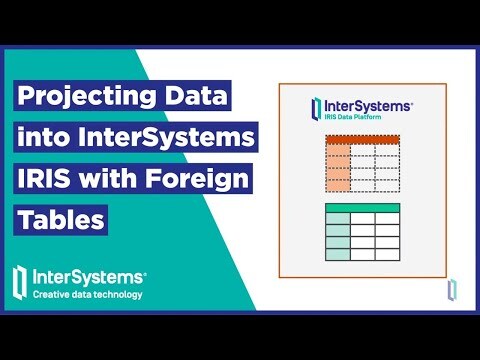
Projecting Data into InterSystems IRIS with Foreign Tables

Exploring Relational Databases

As we've established, relational databases use tables to store data and manage relationships between pieces of information. They rely on a structured approach to organize and retrieve data efficiently.

The Relational Model

The relational model is the foundation of relational databases. It organizes data into tables with rows and columns, much like an Excel spreadsheet. Each row represents a record, while each column represents a specific attribute of that record. Tables are linked through keys. Primary keys uniquely identify each row in a table while foreign keys establish connections between tables. This structure allows for complex data relationships and efficient querying.

Relational databases support data normalization, a process that reduces data redundancy and improves data integrity by breaking down large tables into smaller, more focused ones.

SQL: Structured Query Language

SQL is the standard language for working with relational databases. It allows users to create, read, update, and delete data in tables.

Some common SQL commands include:

  • SELECT: Retrieve data from one or more tables
  • INSERT: Add new records to a table
  • UPDATE: Change existing records
  • DELETE: Remove records from a table

SQL also supports complex operations like:

  • Joining tables
  • Filtering data with WHERE clauses
  • Sorting results with ORDER BY
  • Grouping data with GROUP BY

ACID Properties

ACID properties are key features of relational databases that ensure data reliability:

  • Atomicity: All parts of a transaction succeed or fail together. This means if any part of a database operation fails, the entire operation is rolled back as if it never happened.
  • Consistency: Data remains valid according to defined rules. This means all database operations must follow preset constraints, formats, and relationships, ensuring data stays accurate and logically sound.
  • Isolation: Concurrent transactions don't interfere with each other. This means when multiple users or processes access the database simultaneously, their operations are handled as if they occurred one after another, preventing data conflicts.
  • Durability: Completed transactions are permanent, even after system failures. This means once a transaction is confirmed complete, the changes are saved permanently to storage and won't be lost, even if the system crashes immediately afterward.

These properties help maintain data integrity and prevent data corruption in multi-user environments.

Common Relational Databases

When considering a relational database management system (RDBMS), organizations can choose between open-source solutions and enterprise platforms:

Open-Source RDBMS:

  • PostgreSQL: Advanced features and robust reliability
  • MySQL: Widely used for web applications

These systems offer solid functionality for basic database needs. However, modern enterprises often require more comprehensive solutions.

InterSystems IRIS goes beyond traditional RDBMS capabilities by offering:

  • Multi-model database support (both relational and non-relational)
  • Translytical ability for both OLTP and OLAP (transaction and analytics)
  • Built-in high-performance analytics
  • Advanced healthcare data handling
  • Enterprise-grade scalability
  • Unified development platform
  • Native interoperability features

While open-source solutions work well for basic needs, InterSystems IRIS provides a complete platform that eliminates the need to maintain multiple database systems.

It handles everything from simple data storage to complex analytics, all within a single, reliable environment.

Software developers using computer to write code sitting at desk with multiple screens work remotely in home . Programmer development concept.

Exploring Non-relational Databases

Non-relational databases offer flexible data storage solutions that differ from traditional table-based models. These systems handle diverse data types and scale well for large datasets.

NoSQL: Beyond Traditional Structures

Non-relational databases, also known as NoSQL databases, store data in formats other than tables. They can manage unstructured data like emails, videos, and images.

NoSQL systems don't require a fixed schema - this means different records can have different fields or structures without needing to update the entire database, much like how you can add a new column to just one Excel row without changing all other rows.

These databases are perfect for handling big data and high-traffic websites, often processing large volumes of information quickly and efficiently.

Types of Non-Relational Databases

There are several types of non-relational databases:

Key-value stores

Key-value stores are the simplest type of non-relational database. They function like a basic dictionary, storing data in pairs where each unique key connects to a specific value.

You can think of it like a giant lookup table - perfect for quick operations like managing user sessions, storing preferences, or handling cached data.

Document databases

Document databases take a more flexible approach by storing data in JSON-style records. Unlike rigid table structures, each document can contain different fields and nested information.

This makes them ideal for content management systems, user profiles, and product catalogs where data structures might vary between entries.

Graph databases

Graph databases are great at handling connected information by using nodes and relationships. They're built specifically for data that involves complex relationships, making them perfect for social networks or recommendation systems where understanding connections between data points is crucial.

BASE Model

Non-relational databases often follow the BASE model:

  • Basically Available: The database keeps working even if some parts fail, prioritizing uptime over perfect consistency.
  • Soft State: The database's values might change over time even without new inputs, since updates can happen at different times across the system.
  • Eventually Consistent: While data might temporarily differ across different parts of the database, it will all sync up and become consistent given enough time - like how your email inbox might show different numbers of messages on your phone and computer before syncing.

This approach differs from the ACID model used in relational databases. BASE prioritizes availability and partition tolerance over strict consistency. In BASE systems, data may not be immediately consistent across all nodes. It becomes consistent over time. This trade-off allows for better scalability and performance in distributed systems.

The BASE model suits applications that can tolerate some data lag. It's less ideal for systems requiring real-time consistency, like banking transactions.

Women, owner of small business packing product in boxes, preparing it for delivery.

Scalability and Performance

One of the biggest challenges in enterprise data management is staying accurate and fast as data increases. Database systems must handle growing data volumes and user loads efficiently. Different approaches to scaling and optimizing performance can impact system capabilities.

Horizontal vs. Vertical Scaling

Vertical scaling means adding more power to a single server - like upgrading a computer with better processors and more memory. While this approach works well for immediate growth, it eventually hits physical limits and becomes increasingly expensive, much like trying to make one computer infinitely powerful.

Horizontal scaling takes a different approach by spreading data across multiple servers, each handling a portion of the workload. Instead of one super-powerful machine, you have many regular machines working together. This approach offers nearly unlimited growth potential because you can keep adding more servers as needed. It's particularly useful for handling large amounts of data or many simultaneous users.

Non-relational databases can excel at horizontal scaling by forfeiting transactional consistency.

While relational databases can achieve distributed data storage through techniques like sharding (splitting data across servers), this process is often more complex and challenging to manage. InterSystems IRIS has sharding and as well as other methods such as mirroring (both synchronously and asynchronously) and the unique and powerful feature of keeping distributed caches in sync. This is called Enterprise Cache Protocol (ECP).

The ability to scale horizontally becomes increasingly important as applications grow, especially for use cases involving big data or high-traffic applications where the workload needs to be distributed across many machines.

Data Integrity and Consistency

Data integrity is vital for maintaining reliable information in databases.

A relational database uses constraints to enforce rules and keep data accurate. These include:

  • Primary key constraints: Ensure unique identifiers for each record
  • Check constraints: Validate data before it's added to the database
  • Not null constraints: Require certain fields to have a value

Non-relational databases handle data accuracy differently. They often rely on application-level checks rather than built-in constraints.

Some NoSQL databases offer atomic operations to maintain data accuracy during updates, preventing partial or incomplete changes to the data.

Referential Integrity

Referential integrity is a key feature of relational databases, maintaining the relationships between tables using foreign keys. This ensures that:

  • Data in related tables stays consistent
  • Orphaned records are prevented
  • Updates and deletions are handled properly across related tables

Non-relational databases typically don't enforce referential integrity at the database level. Instead, they may use:

  • Application logic to maintain relationships
  • Denormalized data structures to reduce the need for complex relationships

This approach can offer more flexibility, but requires careful management to avoid data inconsistencies.

abstract database management concept

Use Cases and Applications

Relational and non-relational databases serve different needs in modern data management. Each type is better suited to specific scenarios, from e-commerce platforms to complex analytics systems.

E-Commerce and Big Data

E-commerce platforms often use both database types. Relational databases manage orders, payments, and inventory. Non-relational databases handle product catalogs and user behavior data.

Big data applications often favor non-relational databases. These can process vast amounts of unstructured data quickly. They're used for:

  • Customer behavior analysis
  • Recommendation engines
  • Fraud detection systems

Business Intelligence and Analytics

Business intelligence tools often use relational databases due to how well they executive complex queries and maintain data integrity. They're also ideal for generating reports and dashboards.

For real-time analytics, non-relational databases are often preferred. They can ingest and process data streams rapidly. This is useful for:

  • Monitoring systems
  • IoT device data
  • Social media sentiment analysis

Some companies use a mix of both. They might store raw data in a non-relational database, then they move processed data to a relational database for deeper analysis.

Ready to Build Better with Modern Database Technology?

Managing today's complex data needs requires a solution that goes beyond traditional databases. InterSystems IRIS combines the best of both relational and non-relational approaches in one unified platform.

Why choose InterSystems IRIS?

  • Handle any type of data - from structured patient records to unstructured medical imaging
  • Process both transactions and analytics in the same system
  • Scale easily as your data needs grow
  • Build AI-enabled applications without complex integrations
  • Connect previously isolated data systems
  • Have you database on-premises, in the cloud, or both

Take the next step in your data management journey. Whether you're building healthcare applications, managing financial transactions, or analyzing big data, InterSystems IRIS provides the tools you need to succeed.

Try InterSystems IRIS For Free

Try InterSystems IRIS for free and experience how your business can thrive with a database management system that excels in performance at scale, availability, and security.

Try InterSystems IRIS

Frequently Asked Questions

Is SQL a relational database or not?
SQL (Structured Query Language) is not a database itself, but a language used for manipulating data in relational database systems. Most relational databases use this language for complex querying and data retrieval.
What is the difference between a database and a relational database?
A database is a general term for any organized collection of data. A relational database system is a specific type that stores data in tables with relationships between them, often using primary and foreign keys.
How can you tell if data is relational?
Data is relational if it can be organized into tables with clear relationships between different entities, and if it benefits from a structured schema. Relational databases store data in a way that allows for complex SQL queries.
What makes a database relational?
A relational database uses tables to store data, establishes relationships through primary and foreign keys, adheres to a predefined schema, and typically uses SQL queries for data manipulation and retrieval.
Can relational and non-relational databases be used together?
Yes, many modern applications use both SQL databases and NoSQL databases in a "polyglot persistence" approach, leveraging the strengths of each for different data storage and retrieval needs.
Are non-relational databases faster than relational databases?
Non-relational databases can be faster for certain operations, especially with large volumes of unstructured data, but performance depends on the specific use case and implementation.
In what circumstances is it better to use a non-relational database?
Non-relational databases work well for:

  • Handling large amounts of unstructured data
  • Quick scaling of applications
  • Flexible data models that change often
They excel in situations where data doesn't fit neatly into tables.
What kinds of use cases are better suited for non-relational databases?
Non-relational databases work well for:

  • Real-time web applicationsContent management systems
  • IoT data storage
What is the "Not Only SQL" approach?
The "Not Only SQL" or NoSQL approach refers to non-relational database systems that provide flexible data models for storing data. Unlike relational databases, NoSQL databases can handle various data structures more efficiently in certain scenarios.

They are particularly useful in scenarios with rapidly changing data or where flexibility is key.


Related Content

Sep 16, 2024
Fundamentals
Discover what a relational database is, its key features, and why it's crucial for your business. Learn about its advantages, popular systems, and how it compares to other database
Dec 03, 2024
Fundamentals
Discover NoSQL databases: types, benefits, and use cases. Learn how these flexible systems handle unstructured data for improved business scalability.

Take The Next Step

We’d love to talk. Fill in some details and we’ll be in touch.
*Required Fields
Highlighted fields are required
*Required Fields
Highlighted fields are required

By submitting your business contact information to InterSystems through this form, you acknowledge and agree that InterSystems may process this information, for the purpose of fulfilling your submission, through a system hosted in the United States, but maintained consistent with any applicable data protection laws.


** By selecting yes, you give consent to be contacted for news, updates and other marketing purposes related to existing and future InterSystems products and events. In addition, you consent to your business contact information being entered into our CRM solution that is hosted in the United States, but maintained consistent with applicable data protection laws.