


























John Paladino, Vice President, Client Success at InterSystems celebrates the Customer Impact Award winners — chosen by a distinguished MIT judging panel.
The session covers the rigorous award criteria (measurable impact, first-of-its-kind achievement, and the ability to inspire others) and six award categories spanning healthcare providers, health plans & HIEs, health tech, supply chain, public sector, and financial services.
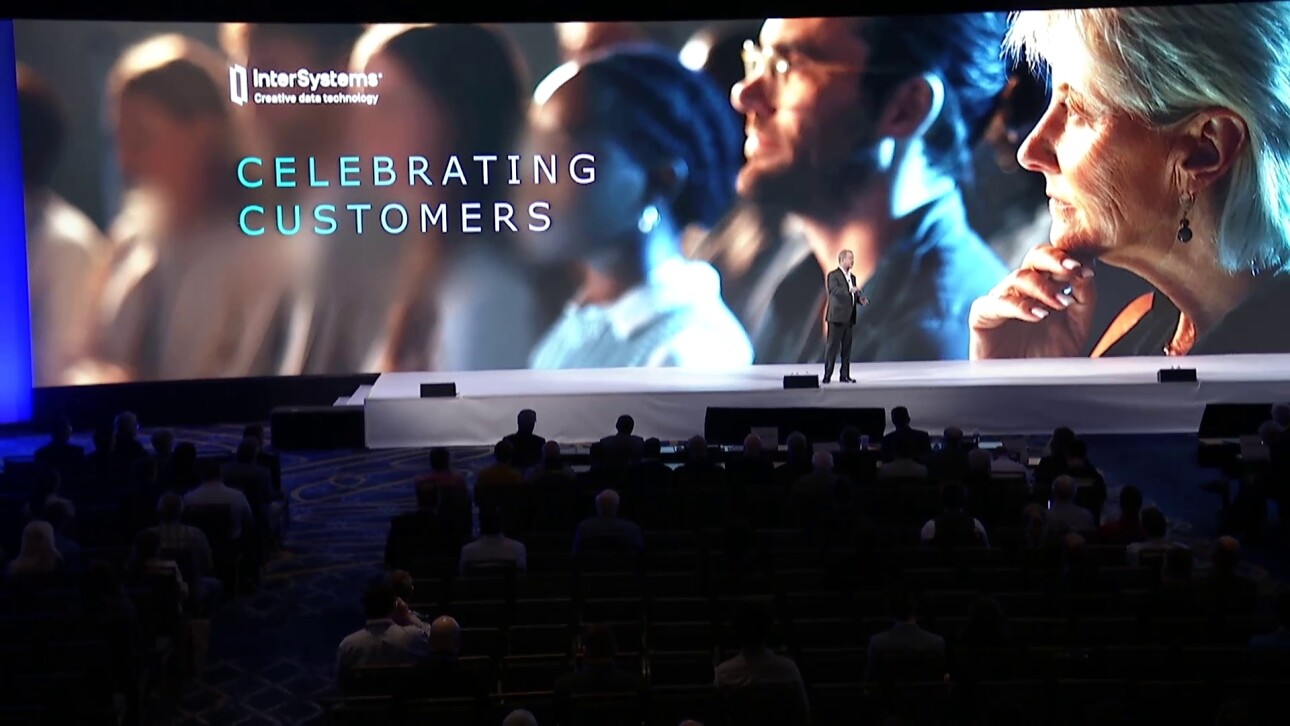
Presented by John Paladino, Vice President, Client Success, InterSystems
Video Transcript
Below is the full transcript of the READY 2026 Keynote with John Paladino.
How's everybody doing this morning? All right. I have to say I really appreciate that you've stayed all three days. So, thank you diehards. And how was the Air and Space Museum last night? Integrity Check is really cool and I think we need one more round of applause for Integrity Check.
And first today's about awards of course. So today we're going to just briefly mention on Monday some of you may know we had a hackathon and we took people that didn't really know each other put them into teams and had them use AI hub to build things and they had three hours to do it. And these are the award winners. And if the award winners are here, please stand up for an applause, too.
Read the full transcript
So, today is about celebrating. We talk a lot about technology and software and what we're doing in different industries, but let's start with stepping back and just reflecting. And start with myself. My passion in life is to help people and I really enjoy solving problems but I prefer technical problems rather than people problems and InterSystems. Everybody here and everybody who's not here as part of the company we're all about helping you.
We love to build things that really work well for you and help you to be successful and then we lean in. We give you as much help, probably more help than you can stand. It's funny, the head of interoperability at UC Davis a few years back hired somebody and told me the story. He said, "I hired this person and was onboarding him and I said, 'Now listen, if you call InterSystems, you don't have time to go get a cup of coffee. You need to be ready to work right then and there.'" So, we're there to help you.
But all of that's good. But what you do and the people you serve, whether it's people, organizations, communities, the things you build and do are really impactful and that's what matters. So what Terry said on day one is absolutely true. We're here for you to make you successful.
Now in healthcare and you've heard a lot about us in healthcare this week. We are the database in healthcare. I'm not shy about saying that we are number one in interoperability in healthcare and that's great but we're also in many different industries. So we're in mining in South America. We're in shipping in the Mediterranean, space exploration. Even ice cream. Ice cream in upstate New York. Stewart's ice cream to be specific. No, Don, it's not Dairy Queen. Sorry.
Most of the US credit unions and collection agencies run on IRIS. And that's been true for decades. And we work with governments in many different ways at all levels. Local and federal police in Europe use IRIS, which you may not know. We have a customer in Australia that has an IRIS-based application for online sports betting. Yeah, the horse races primarily. And then we have another customer in Australia that has an application for gambling addiction.
And of course, we have a new application which you saw yesterday for pet adoption. You saw Jeff describe that yesterday. That was a great picture of Scott and his dog. And I know Dino and Dino is a great dog.
So let's switch to the customer impact awards and talk about the process in which we go through to achieve these awards. These awards are not just a nice thing that we give out. It's totally different. They're really hard to achieve. So there were hundreds of contestants for these awards and in total we selected 23 and it took four months to go through the process of selecting the awardees.
So the criteria are really important and we set a high bar with everything we do quite frankly. You heard Don say that if you get into MIT, you might get into InterSystems. That's a pretty high bar. So, we set a high bar for these three criteria. The first criteria is you have to do something that really makes a difference. Something that would make all of us say, "Wow, that's incredible." And I have some examples I'm going to go through of that type of impact. It has to be something that's never been done before. That's a very high bar to achieve and it has to set an example and inspire anyone who wants to do something similar. And you've all been talking this week and there were lots of similarities in what you do. But it also has to be something we can measure.
Oh, I'm sorry. I'll come to that in a minute. Let me talk about the judging panel. So we don't pick the winners, the panel does. And this is a very distinguished group from MIT. And I want to talk about who they are so you understand these are really special people that are going through all the contestants and they select the winners.
Phil, we first met Phil when MIT started the corporate innovation program and we were one of the four founding companies to join that program. We learned a lot together and it was a great experience. Phil's a PhD. He went to Oxford Cornell. His PhD is in international political economics. He was a British diplomat both in England and the US. He lectures at the Sloan School at MIT and we're very lucky to have him on the panel.
Doug has an electrical engineering degree from Princeton and a PhD and MBA from Harvard. He's an MIT strategist for a platform at MIT called Orbit. And Orbit is a platform used in the entrepreneurship program. So he's in charge of that. He's also a serial entrepreneur. So he's started many companies.
Andrea is also very interesting. She's an entrepreneur in residence at MIT and she wrote a book called From Stuck to Scale. Maybe you've heard of it. If you haven't, you should check it out. She's worked with entrepreneurs and universities on innovation programs in Africa, Latin America, Southeast Asia, and beyond. She's also appeared in many TED talks and she's a sought-after speaker.
Manolus has been here with us this week. He's worked with the contestants and the judges to get the information necessary to make decisions. He's a PhD of computer science at MIT and he's a full professor teaching computer science and AI at MIT. He also directs the MIT computational biology group. He's won many, many awards. We're grateful for all of his help.
So, this is a really elite group of people that look at what you are doing and make a final decision on who the awardees are. So, we want to see this year quantifiable financial impact either cost savings or revenue growth or even better both. There are six different sectors, three in healthcare, three in non-healthcare and three different awards, regional awards, world awards and AI that works, AI in action. Each of these is equally distinguished. These are incredible awards. I've been told some people have come here just to try to win the award.
So, let's do a drum roll. You're the drum roll. So, what you're going to do All right, keep drum rolling. I didn't say stop. All right, let's look at who the awardees are in these six different categories. We have many organizations. And before I go through each of these, I'd like the awardees to stand up for an applause. So, we've tried to make this a really special time for the awardees. We had a reception with all the awardees in which we gave out the awards to each of the teams, took a photo op, got applause from everybody else in the room, but then Georgia came up for their award and all of a sudden the Georgia Hen came up and the room exploded. So Georgia's got something going on. We also met with each of these groups together.
So we met with the healthcare provider group and the financial group to allow them to talk to each other, give us a chance to ask questions, to hear directly from them what they've achieved and what the challenges were. It's really interesting and there were some common themes we heard with each group. So I don't have time today to go through each organization I wish I did but there's a write up on each one if you want to read through it but I want to talk about what each group achieved and what the common denominators were.
We'll start with providers. So providers their big impact was both cost and revenue. As we know providers profit margins if they have any are very slim. So this is a very important thing. So the first common denominator that we heard was about AI disruption and leveraging AI and one of the organizations told a story I want to share. The leader of the team told the story and he said for care quality and care quality improvement we have a process, we have one of many processes but one process is doctors sit down together in a small group and they go through charts and medical records for recent activity in patients and they look for ways to improve. That sounds fine but they can't do it on all data of course so they do it on a sample but the sample set they use is less than a half percent.
So the guy who was telling the story said, "That's crazy. Use all the data. We have AI. We can leverage it." So he wanted to change the mindset to improve care quality. He applied AI on all the data, fed it back to the same clinicians that do the evaluation and assessments, and refined it to the point where they could make decisions on improving care quality using all the data. That's an example of AI being disruptive and having a great impact.
They also optimize workflows of course. I visited a hospital in Italy and they said the path to improving financial results is by optimization. So we can see more patients per day with the same level of quality and integrated workflows. And you'll hear more about this as I go through each of the groups.
So, funny story, one group, the head of the group, the CIO said he was so happy he won the award. He ran to his room to call his wife and his wife's a clinician doctor and he explained, "I won this award. Here's how we won it and it's great." And she said, "I still don't understand why you won." I think when he gets home, he'll explain it to her.
So, let's move on to health plans and H.I.E. Georgia and Mississippi had such incredible stories. It's not just about sharing health data. It's about community data. I was talking to somebody this morning that also said community data is becoming very important.
So in both of these cases, the common theme was getting housing data, getting food bank data, getting homeless data, even giving information to police for things like domestic situations. Having that information is really powerful and has led to their impact and success. They don't have a lot of revenue. So that's the challenge for them and that's where the impact was.
And the way they achieved revenue growth was to first spend a lot of time earning trust. Go talk to people in different positions around their region to explain what they're trying to accomplish and the vision and to begin to earn their trust. So that took meeting after meeting after meeting and they were successful. And then they built use cases one at a time that deliver value back to the organization sharing data.
Which is interesting because it allowed them to develop a plan, a road map, different use cases, iterate and have more and more use cases that deliver value back to their communities. And by doing so, they were able to fund the growth that they need in order to sustain their organizations. When we met, Andy Zuk was there too. It was a remarkable set of stories about what they've achieved and how important it is in terms of what they're doing.
Move on to health tech. It's about both cost and revenue as you might imagine. Reducing time, improving quality and efficiency. And these organizations, of course, they do different things, but that's kind of the common theme that they had.
Supply chain, forgive me. Supply chain is about reducing interruptions, delivering faster consistently. An example of this is a winner from a couple years ago, an organization called Peltech in Japan. They're the distributor for things you might buy in a corner store, toothpaste and all kinds of items like that. And of course, there are tens of thousands of stores all over Japan. They are the distributor and supplier for tens of thousands of products and they deliver on time 99.99959% of the time in full on-time delivery. That's really remarkable. They're using IRIS machine learning and over the last couple years AI in order to achieve that. And by the way during COVID they didn't falter.
Now for public sector of course this is about reducing costs because public sector has a limited budget. They also have an obligation to taxpayers not to waste money and to use money efficiently. So they optimize for a region and of course like the plans and HIE it's a socioeconomic impact as well. The interesting thing I heard that they all gravitated toward was a comment about using data to make good decisions. They said data-based decisions are safe decisions.
And lastly, financial services. Of course, this is cost and revenue, but the interesting thing I learned there is they all used IRIS Data Studio plus AI, and they had this concept of a backbone as Don was describing earlier. They have all these disparate systems, many of which are legacy systems. They're old. So rather than replace them, they have a new mindset, have something that sits over these systems, gets the data that they need, allows them to come up with new workflows to support new applications and bring all the data together in a way that they can use it.
And each of these has been incredibly successful. The common thing in all of these is the backbone concept. It's the interoperability to bring data together and figure out how you want to use that to operate and having the right data. Not all the data in like a data lake but the data you need right now. And each one of these was focused on optimization and they have a high value impact. And I'm laughing because one of the health plans said one of the things that made them successful was the InterSystems magic, meaning bringing the data together in a way that they can use it. So the InterSystems magic is also a common theme.
So in the category of AI there are two winners and I want to spend a little time going a little bit deeper into these two organizations and what they achieved. So, Auda Ashtad is a public hospital group in Israel, but they have a very diverse population from all over, right? They have people from Africa and from Europe and all over the place. And that gave them an opportunity. They thought we have information that might be useful to other organizations. So they took this data, this health data and put it together and anonymized it and put it into a sandbox which they call the Auda Medical Sandbox and they made it secure modular AI-driven and it fosters innovation through research and partnerships with pharmaceutical companies with startups with their own organization as well.
It integrates EMR data, imaging data, surgical videos, lab data, pathology data, so forth. So you get a comprehensive view of the patient journey. The anonymized data has been used to build applications as well. So that people can test the applications on real data, but it's anonymized. There are three applications I want to mention.
One is Blood GPT and if you go to bloodg.com you can learn about what this really is. I was looking at it last night. It's pretty fascinating. It's predictive blood test analysis to be used both by patients and doctors. Second application is Tailor Path which is for personalized care pathways. And the third is Platemate. It's a catchy name. And that's for customized hospital patient diets. So this has had a huge revenue impact. Of course, they're a public company.
So what they do with the revenue is they put that back into innovation. So their innovation is building to do more exciting things. But they won the award because they had this concept and idea that they could find a way to safely, securely, ethically share anonymized data and monetize it. So very few organizations have done that.
The next is UCIS. UC Chris is a Catholic group of hospitals throughout the US, Central America and South America. This particular group is a customer of ours in Chile. They have a million outpatients per year in this group. They have about 500 beds. They have 6,500 staff, but they also have long-term care patients, people who stay in the hospital for months. So, their medical record is of course huge.
And they deployed TrakCare. That's actually not the most interesting part. We have lots of TrakCare deployments happening all over the world. But the way they approached it was interesting and it had a different impact than other implementations. They treated this as a clinical engagement. They treated this as a clinician-led implementation, not an IT implementation. So it gave the clinicians, the doctors a chance to look at what they're currently doing on paper and what they would ideally do if they could change things and to develop workflows that work to their advantage. It saved them time, saved them energy, and so they can see more patients per day. So if you can imagine the mindset they had to be able to come together as a clinical group and figure out how they're going to change health care in their organization. That's what they did. Clinician first.
They also implemented ambient. They did a couple of things with AI. So they did this on their own. This was not part of the TrakCare implementation but they brought in ambient. So listening to a patient and doctor exchange and then writing up notes and writing up summaries, drafting that for the doctor saves a ton of time. And they're also using AI for other types of documentation that happens in healthcare.
So they've been incredibly successful. They've won national awards. They presented this at HIMSS last year. And the president of the organization as well as the doctors using the system have both come back and said to the implementation teams, "Please do more and do it faster. We love this stuff. Let's keep going." So, what they accomplished is they lowered cost and they're seeing more patients per day and it's a unique way of implementing any EHR. So, they led the way. They did something different. They changed the mindset which is a common theme and they accomplished something great.
In fact, the group from MIT looked at this and they said this is really incredible. This is like the best of the best. We want to have a best of the best award. But I just wanted to mention that as a comment because they were so impressed with UC Chris.
So, the customer impact awards are a great way for us to listen about some amazing things that you're doing and you deserve the awards for accomplishing those. And this event has been terrific for us to listen to you, to learn from you, to learn from each other and to learn from us as well.
But the learning and interaction should not stop today. So if you have goals, aspirations, and ideas, talk to us. Ask us. It might be something we have already. It might be something we're thinking of doing, maybe something we are doing or should be doing. Or maybe we should just do more to help you. So, let's keep our conversation going.
And I want to congratulate the award winners again. And thank you all.