


























In this keynote presentation from InterSystems READY 2026 conference, Don Woodlock, President of InterSystems, discusses a simple but powerful insight: "There is no AI strategy without a data strategy. And there is no data strategy without an interoperability strategy." Don unpacks what this means in practice, introducing the concept of the AI Digital Backbone — a unified platform that organizes data, enables agentic AI to take real actions across enterprise systems, and provides the governance and security infrastructure needed to make AI safe and effective at scale.
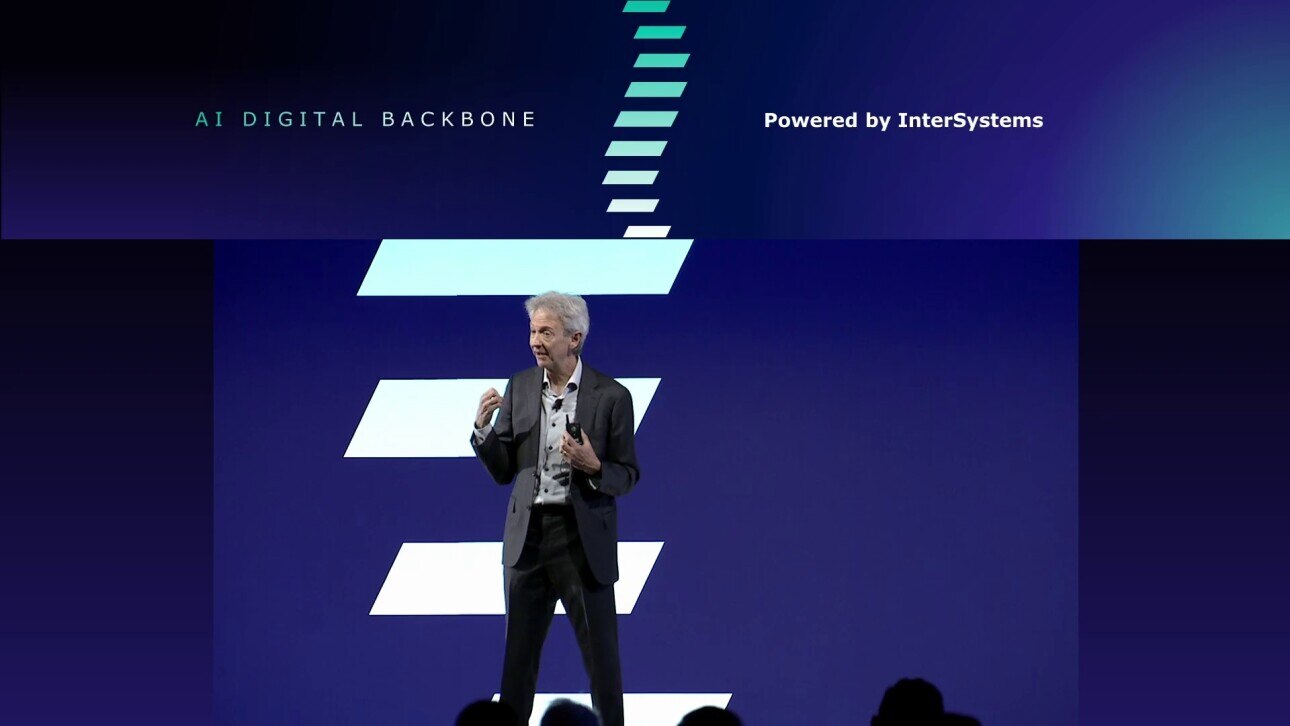
Presented by Don Woodlock, President, InterSystems
Below is the full transcript of the READY 2026 Keynote with Don Woodlock.
Video Transcript
This is my favorite week of the year, at least work-wise, I would say. And the reason that’s so, I’ll explain by telling you a little bit about my very first professional job experience. This was not the Dairy Queen experience, but my first real professional role. I graduated from MIT, and at the time electrical engineering and computer science were very closely related. Software and hardware were a little more connected then, so when I graduated with an electrical engineering degree, I could pursue either kind of job.
So I interviewed for electrical engineering roles, and I could picture myself exactly the way they described the work: sitting in a basement with my oscilloscope, wiring together a small circuit that would eventually be sold to a company making speakerphones, then to an office supply company, then to a hospital, and eventually there would be an end user somewhere who benefited from my work. But I never felt like I would actually meet that end user. There would be so many steps between me and the person benefiting from what I did.
Read the full transcript
And then I interviewed for software jobs. And I just got a different feeling that I could actually talk to the end users. They would tell me what they wanted and I would code it and I could see their smiling faces when I delivered what they asked me to do. And that turned out to be exactly the case. So I joined a company named IDX and some of you may know that company. Yes, some of you may be from there. And we used InterSystems technology at the time so I was a developer on our technology many years ago and one of my first projects was in Albany, New York. Community Health Plan was an HMO and I was working on the claims adjudication system and in the morning I would bring over all the claims ladies. They were all ladies on this floor.
So I'd bring them all over and I'd say, "What would you like the software to do? How would you like it to be better?" and they would tell me all the changes that they would like and all the different logic and screens and stuff like that. I'd say, "Okay, great. Go back to your desks. I'm going to code that for you." and I'd spend the next couple hours coding. And then in the beginning of the afternoon, I'd bring them all back and I'd show them the new release. Basically we deployed it to production right away. So, it was a little simpler time back then.
But at any rate, I'd show them the new release and they'd say, "Oh, that's great. I love it." And make these 10 more changes and I would code for the afternoon and do the same thing for the whole week that I was there. And that was fantastic. Those were very happy days of being very connected to users and delivering what they wanted. And those happy days have continued throughout my whole career. And I feel that way now still. And there's a whole company of people like me that love interacting with you. Love hearing what you would like us to work on. And then going back and enhancing our software and building new products to meet your needs. So that experience continues and that's why this week is so valuable to me and so valuable to us as a company.
When I then joined InterSystems a little bit later in my career, I felt like I had walked into the Emerald City. I don't know why that's up there, but it was just a different kind of company and we think of ourselves as different by design from a company point of view. And I started on a Monday morning and basically the first meeting on this Monday morning. And every Monday morning since, in the eight years I've been there, and I'm sure the decades before, is the same meeting. All of us senior managers get together and we talk about you.
So we go through customer conversations and events through the week. And this really sets the tone. So the way it works is we get together first thing Monday. We have a report that John Paladino puts together. And this is from all the service folks around the world dealing with you. So we get a feel for what are the service issues that came in last week, any downtimes, any disruptions, any new volume on our systems, anything that we should be aware of. So we review that and then we go around the horn and everybody talks about two or three customer conversations they've had in that prior week. It might be new projects that you're starting or events in your community, a new competitor, an acquisition. It might be a new project that you would like us to do. Those kinds of things.
So that's what we do. So, we don't talk about budgets. We don't talk about, I don't know, parking lot issues or any internal stuff. It's all really about you guys first thing for the week and it really sets the tone for the rest of the week. And I can say over the years, I'm sure each and every one of you have been discussed in this Monday morning meeting, but this is a really central part of our culture, is to be customer focused. And this is one of the techniques we use to sort of keep that first in mind as our work week gets started.
So there's a couple other important parts of our business model. So that first one that I just described is what we call partnership. So by partnership we mean that we're focused on your success and if you're successful in your communities, in your businesses, then we'll be fine. Then that will flow back to us.
So the second piece of our model, Terry mentioned it yesterday, is being private and independent and kind of free from outside influences. So this really enables us to stay focused on you but also to make long-run decisions. So we're not worried about the quarter or anything in the short term. We can invest, we can think about the long term and the long-term health of our technology and all of you and of the company. So that's a really important part of our business model and that will be true in perpetuity as Terry mentioned yesterday.
And the third important part of our business model is the passion of our employees. You may have heard that we're very selective in the process of inviting people into the company. We have a technical test, we have a logic test, we have a personality test, we have all kinds of interviews. We really look for people that are special: smart, nice, a good fit with our culture. And that's basically the way into InterSystems and we're in Boston, we're kind of down the street from MIT and from Harvard. And both of those schools, where we get a bunch of our new employees, have like a 3% or 4% admission rate.
And if InterSystems measured the same way, it has a 1.1% admission rate. And so I always say if you're smart enough to get into MIT, you're on your way to being smart enough to get into InterSystems. But it's great, it's great to have a group that's passionate about technology, committed to you, excited about learning from each other, learning from you, and kind of driving our company forward. So, it's a really important part of the way we operate.
So one of the things that this has enabled us to do is we think of it as being built for change. So we've been through a lot of technology revolutions over the course of our lifetime and you as well. Many of you have been partners with us for decades.
And this notion of being passionate about technology, investing for the long term, not needing to chase something in the short term, really helps us kind of navigate the technology changes that come upon us and technology opportunities, frankly, and AI certainly being the era that we're in now.
So in terms of where we're investing, basically we're investing in areas that we think are important to you. So I'll just highlight those here. So we have investments, in a sense, or priorities that are sort of tried-and-true priorities that we continue to make sure are our highest priorities. And then we have certain things that are transformative where we want the company to change and take advantage of new things in terms of tried and true.
The first is any commitments we've made to you. So that's always our top priority. So if we're mid-project or mid-go-live or we've committed to you on a service issue or anything like that, our top priority is to do what we say we will do. So we really value when we make commitments to you that we come through on those commitments. So that's always our number one priority.
The other second one is what we call speed, scale, and security. So we always want our technology to be the fastest, to be the most scalable, to be the most secure. We're kind of obsessed with having our technology really be the best and get better with each release and every year. And so that's something that you can count on us for.
And the third is service excellence. So we feel good on this front. Some of the analyst groups have said that InterSystems service is in rarified air, which we really enjoy. But we intend to stay that way.
So, yesterday I was having lunch with one of you, sitting at a table with one of you, and you mentioned how great our WRC was. And what this guy said, which is rather funny, he says, "When you issue a ticket with WRC, you better be ready because they're going to call you back right away. So, you can't issue a ticket and then go to a meeting or go to lunch or something like that because you've got to be ready for that call." And so he was contrasting that with another vendor where two or three days later you'd hope to get a call from this vendor, that sort of thing. So we like that. We like that we have that responsive service reputation and we intend to keep that as part of the company priorities.
And then here are three areas where we're investing to be different. So one is AI. Of course, we've been investing in AI for the last few years. But this is an area that's quite transformative for our industry, transformative to software and our world, frankly. So we're investing there in a number of different areas to use it internally, to put it as part of our end-user applications so the users have an increased experience, smarter software, a more natural user experience, that kind of thing, and then build it into our platform to allow you to build on top of that and build AI experiences for your users.
Second is cloud. So, we want the value that we deliver to you to be in a click-go experience, that you can take advantage of our technology without necessarily having to buy hardware and run data centers and have a management experience around it. That you'd be able to take advantage of our value in a kind of technology service sort of way.
And then the third transformative area is building end-user solutions. So we've always done this but we keep investing and prioritizing some of this. So we have plenty in healthcare and in financial services and supply chain where we're building specific solutions for different end-user markets. So that's a third priority for us.
So these are the investment areas. You'll see a lot of that this morning as we go through the demos and certainly in the afternoon sessions as you learn what we're up to in each of the different product areas you might be interested in.
So now, to just double click on AI a little bit, we had a presentation yesterday, the first keynote, and he said there is no AI strategy without a data strategy. Do you remember that? I was furiously writing it down as he was saying it. And then he said there is no data strategy without an interoperability strategy. And we really believe that.
And so there's a lot in the AI landscape. There's a lot kind of above the waterline: models and prompt engineering and tooling, MCP servers, that whole kind of LLM experience on top, chatbots and such. But below that, below the waterline, there's a foundation that we feel needs to be built in order for AI to really work well.
And that foundation consists of data. Organizing your data in a way that either can train models or be available for RAG implementations or MCP server implementations. So these LLMs tap into data to get their job done properly.
The second area on interoperability, as we move into agentic AI, the spirit of agentic AI is that the AI doesn't just write, it doesn't just give you an answer in a chatbot, but it does things. It calls tools, it calls APIs, it updates databases, it connects itself to the other systems in your enterprise and gets stuff done. And this makes AI powerful and valuable, but it needs to be connected. And that's where interoperability really fits in, that AI as kind of isolated is only so useful, but connected we can really drive and take advantage of this next wave of AI around the agentic AI experience. So that's where interoperability we see evolving into.
And of course, domain knowledge is another thing that's quite important from a foundational point of view, is really assessing the AI opportunities that you have, connecting that with the real value you need from a business point of view, what your users are asking for, that kind of thing. So we always view domain knowledge as super important.
So how do you instantiate a data strategy and an interoperability strategy? How do you pull it all together in order for you to be successful in this kind of AI era? We think of pulling this all together as building an AI digital backbone. So a place where you organize your data, where you have a strong interoperability foundation, where you have solutions around governance, around auditability, around logging, security, these sorts of things to make sure that your AI use cases really work and are really valuable and are safe and effective.
So when you think of a backbone, let's think of a backbone in us mammals, let's say, a backbone has this characteristic of strength. So you want a strong foundation. Of course, it gets us to stand up and hold our weight and that sort of thing. But a backbone is not a steel pipe, right? It's flexible in a sense, it's got the vertebrae. It has an ability to move and bend and withstand impacts of a certain size, that kind of thing. So a backbone is both strong and it's flexible. It's modular, that kind of thing.
And the other thing about a backbone in an animal, at least, is it protects the communication that goes throughout the body. So it really opens up that communication channel. So that's why we kind of think of this AI platform as a digital backbone in that way and let me elaborate a little bit more on that.
So if you think of your organization, your users, they're asking you for use cases around AI. All of us are like kids in a candy store.
There's so much candy we can get from an AI point of view. There might be use cases around unifying your data, interoperability, digital front door for — I'm using healthcare examples here — digital front door for patients, research, those kinds of things. So you've got probably 50 use cases that your organization would love and each of those use cases could be implemented independently. This use case needs to connect with these two systems. This other use case needs these three systems. This third use case needs this data, that sort of thing.
But they all really have to interact with the systems of record that you see on the bottom of this slide. And so you can either one at a time implement these use cases or you can pull it all together with this digital backbone concept where you make that data available. You build that strong interoperability foundation. You build the types of things you want in terms of validation, governance, logging, those kinds of things to really make this work well for your organization. Make it easy to implement subsequent use cases and manage the whole journey to take advantage of AI in a more refined and platform way. So that's essentially the way we think about positioning yourself for AI moving forward.
Now the backbone itself is different for every kind of vertebrate in our animal kingdom and all of you will kind of need a different backbone for your organizations. But whether you're 10% of the way there or 90% of the way there we hope with our technology we can help you get to the 100% mark and really be successful in the AI journey.
So, lastly, I'm not going to steal anybody's thunder, but you'll see a lot of examples of this through the course of the morning of where we're investing AI, data, interoperability solutions, that sort of thing. So, we hope that's all going to be clear as the morning ends.
So going back to my experience in Albany, I was a solo developer in one organization with a group of users and I've made my way through my career and now I get the pleasure of representing a couple thousand of us at InterSystems. But the concept is still the same. We're here for you. We're interested in how we can help you grow, where you're heading, and we want to provide that technology that allows you to transform within your organizations and your communities. So, thank you very much.