


























In this keynote from READY 2026, Senior Vice President Scott Gnau presents a comprehensive look at how connected, interoperable data systems are transforming care delivery across providers, health plans, HIEs, rural communities, government, and MedTech.
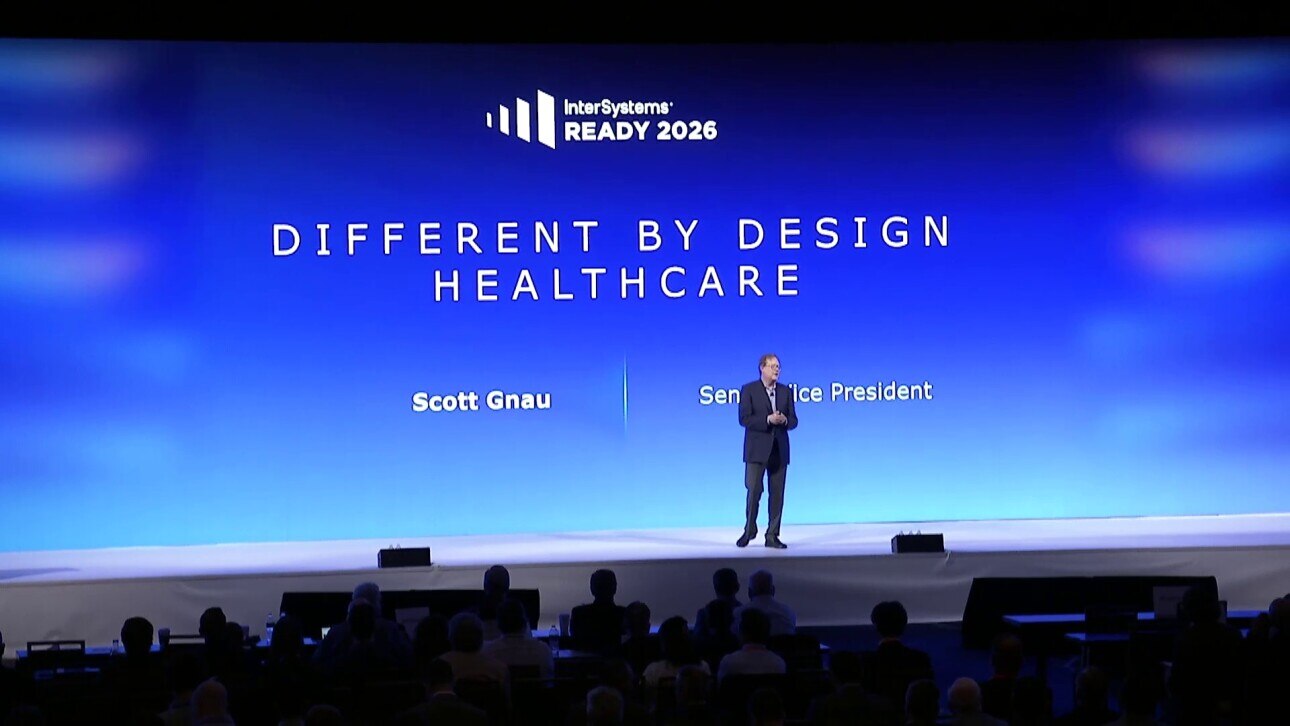
Presented by Scott Gnau
Video Transcript
Below is the full transcript of the READY 2026 Keynote.
[0:00] Good morning again — your lucky day, you get to see me twice. And I'm thrilled to be back to talk a little bit more about our healthcare solutions. "Different by design" is the theme that we started last year, talking about our data platforms. Don talked about "different by design" in our company, and I'd like to give you the landscape of our healthcare solutions — but I would like to start with a personal note.
[0:29] I grew up in rural Pennsylvania, not far from Three Mile Island — I mentioned that before. And this is where accessing healthcare was often difficult. Getting care could often mean long drives, a few local options, and a great deal of effort just to move from one part of the system to the next. That experience shaped how I think about healthcare, because in rural communities the challenge is not only whether the care is available — it's whether people can actually access it, whether the information follows them, and whether care teams — often separated by distance and stretched resources — can work around the patient's needs.
[1:07] And when that doesn't happen, the consequences are not abstract. A missed follow-up can lead to a complication. A delayed referral can become a later diagnosis. And a medication change that doesn't reach the next clinician could become a safety risk. I live in Boston now, where access to care looks very different — but that contrast has only reinforced a lesson for me: when healthcare does not work as a connected system, communities are often where the cost is felt first and most deeply. And that's why coordination matters.
Read the full transcript
[1:42] Healthcare is hard, and it relies on systems to work cohesively. And when that fails, what you see is clinical deterioration, preventable events, operational delays, duplicate work, avoidable ED visits, and people getting lost — dropping out of the very system designed to care for them.
[2:04] So how do we solve real problems like these? We solve them by delivering the ability to integrate and provide valuable, complete data across the ecosystem — so it's clean, usable, and AI-ready — and then we make that data impact the real world to solve real problems. We provide ways to build the workflows and applications that you can trust. We enable you to connect the systems and partners that you already rely on. And we offer solutions for you to buy when you need identity management, longitudinal records, population insight — at scale.
[2:48] So we talked earlier about interoperability and how interoperability truly is the backbone of our "different by design" healthcare portfolio — which allows you to build, connect, or buy specific and discrete solutions.
[3:06] Let me talk about Build first. Last year, you heard about our cornerstone partnership with Epic on this stage — how Epic has built their EHR on InterSystems technology — and that requires trust and the breadth and depth of what we do. We also heard from Blue Cross Blue Shield Association about how they have built a hub-and-spoke model for health plans. And it goes further: when you build on a platform designed for healthcare data, you can create modern experiences that directly improve lives.
[3:45] Here in the US, Cordanisa — an innovative nurse-designed platform — fundamentally transforms field care delivery and uses InterSystems to reduce application development cost and complexity by 95%. In the UK, eConsult uses our technology to support patients getting help and advice for free, from anywhere, through NHS digital triage. And in Australia, Southwest Alliance of Rural Health and Barwon Health use IRIS to make healthcare data available in real time for AI, machine learning, business intelligence, and clinical intelligence — building an AI-ready data foundation specifically for rural healthcare.
[4:26] So that's Build — creating solutions and workflows that expand without having to rebuild the plumbing every time.
[4:36] Whatever the systems are, and whether they're built on our technology or others, they definitely need to talk to each other. And this is where Connect is so important. This is where interoperability as a backbone becomes real — because siloed systems don't meet care needs, and point solutions fail. According to a recent CHIME survey, 60% of healthcare IT leaders oversee between 250 and 1,000 applications, and some support over 3,000 applications across the enterprise. That's why integration is not optional — it's the central nervous system that makes everything around it work.
[5:21] In fact, two-thirds of the world's best hospitals use our products. And it's not just providers. Many of our HIE customers are already doing this at a regional, state, or national scale — building the connective tissue across competing organizations so data can move with the patient.
[5:37] In rural healthcare, the need goes even further: helping communities, regional partners, and care networks function cohesively across distance, resource constraints, and uneven access. And that's why today I'm so happy that we're announcing InterSystems Regional Health Connections — designed to meet the needs of rural healthcare.
[5:56] InterSystems Regional Health Connections is built for the reality of rural transformation, and it has to happen across a region — not just inside one organization. It helps rural providers, health systems, community partners, and public sector stakeholders build a more coordinated foundation. When regions are better connected to care, they can stay local more often. Specialist expertise can reach further. Transitions can improve. And data becomes more complete, current, and useful.
[6:31] This is interoperability as a backbone — in practice — a coordinated infrastructure that helps rural healthcare become more accessible, sustainable, and effective. And our entire portfolio is optimized around pulling these things together to create care with the patient at the center.
[6:55] One of our HIE customers, HealtheX, does this at phenomenal scale already. Each month, more than 1.2 million records are viewed. In fact, each year, they receive more than one trillion inbound messages — which speaks to their scale.
[7:18] The holy grail for all of us is clean, usable clinical data. AI that works requires more than data — it requires data that is trustworthy and ready: complete, correct, current, and contextual. And we continue to build out tooling and capabilities for data provisioning and transformation so that organizations can move from connected data to usable data faster.
[7:41] And finally, when you need a use-case-specific solution, we have things you can Buy. This is where you and organizations like yours leverage solutions on top of the foundation we've been discussing this morning — for clean data and system-wide coordination. Capabilities that meet specific use-case needs: a longitudinal record that's usable in workflows, notification services, cohorts and population views, and prior authorization.
[8:11] East Tennessee Health Information Network leverages HealthShare Unified Care Record to help healthcare organizations improve continuity of care and patient outcomes — providing fast, reliable, and secure access to over 1.5 billion clinical records. Today, this nonprofit connects over 500 locations across Tennessee, serving more than 120 participants ranging from hospital systems and health plans to EMS agencies, coroners, and rural pharmacies.
[8:42] For comprehensive identity management, HealthConnect Texas uses InterSystems Enterprise Master Patient Index — and they currently have 23 million distinct MPIDs being managed in their system.
[8:59] And in our global EHR business — in TrakCare — our users at EMC Indonesia are seeing fantastic results across their eight hospitals, with AI automating about 52% of routine documentation tasks, and AI-assisted information retrieval decreasing from over seven minutes to just one to two minutes.
[9:17] So let's put it all together. This isn't just a set of products — it's a cohesive portfolio designed to work together to meet real healthcare needs. Organizations can start wherever they are and still end up with a cohesive system.
- Build on InterSystems IRIS for Health and InterSystems Data Studio to create workflows and data products.
- Connect with HealthConnect and InterSystems Payer Connector to link clinical and administrative ecosystems. Extend that model regionally with InterSystems Regional Health Connections — designed to support more coordinated rural ecosystems.
- Buy with HealthShare Unified Care Record, EMPI, Provider Directory, HealthInsight, and more — to standardize to shared foundations that make it scalable and measurable.
[10:05] Together, it's interoperability as a backbone — producing clean, usable clinical data so we can deliver AI that works and solve key challenges with fully built products.
[10:19] And while the expression of the problem varies by market, the underlying need is remarkably consistent.
In providers, it's about turning fragmented patient information into something clinicians and care teams can actually use at the moment care is delivered.
In health plans, it's about reducing administrative friction and connecting clinical and operational signals early enough to improve experience, costs, and outcomes for members.
In HIEs, it's about becoming trusted connective tissue across a community — making the record more complete, more current, and more useful wherever care happens.
In communities, it's about making distance less dangerous — so that care coordination, specialist input, and follow-through do not depend on geography. And increasingly in rural America, that means thinking regionally: creating the shared connections that help local care remain viable while making the broader system work more cohesively around the patient.
In government, it's about seeing the full population clearly enough to respond, report, coordinate, and build healthy citizens.
And in MedTech, it's about turning device and diagnostic data into timely, actionable insights so clinicians, care teams, and patients can make better decisions with less friction.
[11:44] Different segments, different pressure points — but one common requirement: interoperability as the backbone, so data becomes useful, actionable, and ready to support better decisions.
[11:51] So I'll end here where I started — in rural Pennsylvania on the family farm. The challenge is not theoretical; it's personal. It is a reality of distance, delayed access, stretched resources, and often a system that leaves patients and families to do the work of holding care together.
[12:14] And that is why the real challenge in healthcare is not just collecting data, not just connecting systems — but making sure that knowledge moves fast enough, clearly enough, and reliably enough to change what happens next. Because at the end of the day, the goal is simple: to make care real everywhere.