


























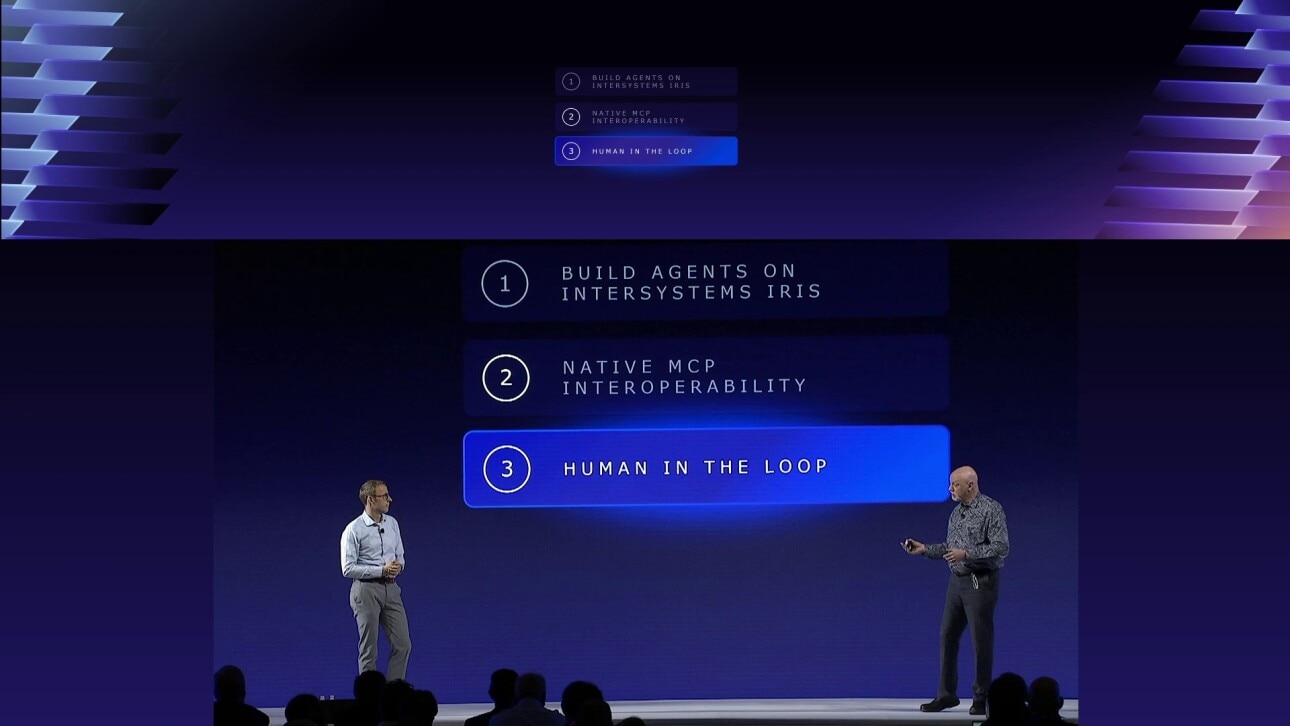
What does it actually take to win in the agentic economy? In this live demonstration session from the READY 2026 InterSystems User Conference, three InterSystems product leaders walk through a complete end-to-end scenario — from raw, fragmented data across hundreds of organizations to a fully governed, AI-powered agentic workflow with humans in control.
Gokhan Uluderya, InterSystems Director, Product Management, opens by framing the challenge: to succeed in the agentic era, organizations need more than a powerful model. They need AI-ready data as fuel, agentic interoperability as the engine, trust and governance as the guardrails, and their own domain expertise as the driver.
Jeff Fried and Benjamin De Boe then take the stage for a live demo built around a real-world problem: the fragmented, inefficient system for animal shelter adoption across the United States and Canada. With millions of animals in shelters and millions of people looking to adopt, the mismatch is a data and interoperability problem — exactly the kind that InterSystems technology is built to solve.
Presented by:
Gokhan Uluderya, Director, Product Management, Data Platforms, InterSystems
Jeff Fried, Director, Platform Strategy, InterSystems
Benjamin De Boe, Analytics, Product Manager, InterSystems
Video Transcript
Thank you. >> All right. I was excited and it just added to the excitement. So it's always a pleasure and of course a privilege to be on this stage year-over-year. But it's also an opportunity I think for me to kind of reflect back and look at what happened in the last few years. So when we look at the last few years, what we see is a lot of disruption in the technology industry.
Obviously, thanks to the AI revolution that's going on, the AI transformation, we hit we go through certain moments in history where the tipping point changes not only what we can do but also what we are capable of imagining. And I think we're going through another one of those tipping points right now with aic revolution. We are spending billions if not trillions of dollars on AI infrastructure. It's reshaping, changing our economy. For the first time, we as humans are not just using computers or interacting with them. We are actually partnering with them. We are interoperating with them in decision making.
Read the full transcript
For there are a lot of new technology giants that are emerging a new generation of tech companies. So the question for all of us everybody in this room all leaders is are we agent ready and what are our differentiators in a world where even the AI itself is getting commoditized so quickly. Agentic economy is here and it's here to stay. And the race is on.
So, what I'd like to talk about is how we're building that foundation for success for all of us to be successful together and how we're actually going to win in the in this high-speed race to win in this new economy. We need more than just a strong model. We need a very vibrant high performance ecosystem.
First, we need the high octane fuel. AI ready data is the agentic fuel. Our data needs to be trusted and meaningful. Just good enough data unfortunately is no longer good enough. It can actually be a liability. It can slow us down, but even worse, it can actually break down the engine.
The engine is agentic interoperability. It is what takes your static information and converts it to kinetic action and results for your business. This is about autonomous intelligent decision making.
Third, we need a safe track and real-time guardrails to run our agents at 200 miles an hour. This is trust and governance.
And finally, and most importantly, we need a very high performing driver. And that driver is you and your context. The real winner in this race is going to be the one that wraps intelligence with their own business knowledge with their own domain expertise and their unique business value. So at InterSystems we provide the great machinery no doubt about it but you and your data your context is what's going to win the race and take us to the podium.
Well, success starts with AI ready data. Our data must be trusted. AI agents need fresh, reliable, highfidelity data for making safe real-time decisions.
Second, data needs to be meaningful. AI agents need context, semantic context, and the understanding that heart rate in one system and pulse in another system can point to the same clinical reality. Shopping cart in one commerce site, basket in another means the same thing.
And finally, data must be governed and traceable. In a regulated world, an AI output without an evidence trail is a black box that we cannot accept. We need catalog data with lineage so that we can explain every decision we make, every decision the AI agents make.
So when your data is trusted, meaningful, and governed, you're not just storing information, you're actually refighting the high octane fuel that you need to succeed in this race.
Okay, with the fuel ready, we now need the engine and that engine is agentic interoperability. This is about intelligent autonomous decision making. It starts with managed and shared context so that the agents have a holistic view of your enterprise. Agents need to be orchestrated. Networks of agents with humans need to be orchestrated so that they produce answers and results for you.
And speed is a dangerous concept without powerful steering. We always need humans in the loop and humans in control. The interoperability engine takes your most valuable asset, your AI ready data, your context, and converts it into your biggest competitive advantage, intelligent, autonomous decision-making.
A high performance car needs a safe track to run on. We provide the security framework so that the blast radius of autonomous action is limited observability gives us a full audit trail so that we can explain things we can audit things and by ensuring every AI output is explainable is validated we give you the safety that you need to run your agents at full throttle with the full confidence of a highly functioning, highly reliable braking system. Now, please keep in mind, safety belts, ABS systems let us actually run faster, not slower.
And finally, the driver, you and your context. While general AI is actually a world tourist, right? Your context, your data is a local expert, a local guide. By being domain specific, private and highly contextual, you're wrapping your secret sauce, your private data around that intelligence that makes the soul of the engine, your context converts artificial intelligence to your intelligence. And when you put the driver in the seat, we are finally ready for action.
Well, let's dig into it. So, what I'd like to spend the rest of time with is actually demonstrate to you how you win in this race by using the InterSystems technologies. We are going to show you a real demonstration of a real life situation that you all can relate to. We'll show you how you build AI ready data with InterSystems data studio. And we're going to show you how to extract insights, knowledge, actions from your data using the AI assistance, newly available AI assistance in the data studio.
And I'm also very proud to announce today the early access preview for InterSystems Iris AI hub. AIHub is a new set of platform capabilities that enable us to build agents and agentic workflows in a trusted and easy way on the same security control and data plane.
And last but not the least, we're going to show you how to build an end-to-end enterprise workflow with Iris interoperability where humans and agents are going to be collaborating in real time together. To solve a real world problem.
I'd like to invite Jeff Freed and Benjamin Dau to the stage to show you a working end-to- end demonstration of this solution. So, please welcome Jeff and Benjamin. Thank you.
Hi there. Thanks, Goken. We're going to take off from what Goken was talk was showing you. We're going to show you some exciting new stuff and we hopefully you'll see how you can use it in the data intensive problems that all of you in the room face every day. We see this kind of problem constantly at InterSystems and even here at the hackathon on Monday at the demo fest last night. I was really struck by this pattern and how it comes up over and over. How you need to bring the data together, interrogate it, take action on it and do so safely with a human loop. This pattern comes up everywhere in health care like public health surveillance in finance such as arranging and optimizing investments and in supply chain just like the year rail example you all just saw.But to illustrate our exciting new stuff, we'll pick an issue that's close to all of our hearts. Animal adoption. How many of you have ever adopted an animal like from a animal shelter? Well, that's a lot. Actually, I'm learning new things about the InterSystems executive team, especially Scott now here. Every year millions of animals enter shelters. They're hoping for a second chance. Some find homes, but many don't. That's a sad story, but it's not just a sad story. It's a systemic one.
In the US alone, 6 to 7 million animals enter shelters every year. And of those, hundreds of thousands, almost a million, do not find a new home. But at the same time, millions of people are looking to adopt pets.
Hang on, Jeff. So, you've got millions of millions of animals in shelters and millions of people looking for them. How can that not match? Well, it does seem contradictory, but it's not just a supply and demand problem. It's about having the right animal in the right place for the right person. There's some shelters that are way overcrowded and then just two states away, there's empty space and no animals. I've learned that 90% of the time adoptions happen when people go to a shelter near them and they meet the pet and they fall in love and take it home right there. If they come in and there aren't animals or there aren't dogs or cats that they fall in love with, they just go home. So, this isn't just a supply and demand problem, it's a matching problem.So why does this happen? It's because the system today is fragmented. Much like you saw with your rail where there's many different organizations. Each step of the process is multiple independent organizations. Their constraints both financial staff power and regulatory constraints. It's hard because this demand and supply are just unpredictable. And it's hard because it requires looking across organizations. And of course, because of sheer scale. In the US alone, there's over 4,000 shelters, over 10,000 animal adoption organizations, over 30,000 vets, and they're all trying to solve the same problem, but they're doing so in isolation.
I think it's I'm starting to get it. So I'm not as much as a person but I'm much more of a data person and this is clearly a data problem. In fact it's very similar to the data problems that you are solving every day. This is when you need to combine data that comes from different organizations or even just within your organization it can get really complicated and it happens to be the type of problems that we love to help you with. So let's see what we can do with you.
Absolutely. I know that Benjamin you'd rather write SQL than feed a squirrel. So, InterSystems Data Studio offers a new approach to accessing data. It makes sure that we can get the right data to the right people at the right time in a secure and controlled environment. It's a fully managed self-service cloud solution with all the necessary components to build a smart data fabric. We'll use the data studio to bring together the data from all those shelters across the US and Canada.
Yeah. Now, we need to bring in data in every format you can imagine. It comes in spreadsheets, CSV files, PDFs with reports inside of them. There's thousands of databases. There are ERP systems. There specialized vet systems that speak fire and XML. InterSystems Data Studio connects to all of them in one screen. Let's show you. So, this is a data studio home screen. Let's look at the sources we have. There's a few with databases. There's a lot that are just sending files on a daily or even hourly basis, and there's a few that are spreadsheets. Let's let's add a new one. We're going to do a national harbor because I've learned there is in fact a shelter here. Click, click, go. That's it.
And once you connect to the source, the data studio automatically discovers the schema, finds the metadata and brings it into a nicely prepared data catalog where all the sources are on a common footing, easy to navigate, easy to examine, and therefore easy to work with. There's dozens of data sources here. They're all cataloged. They're all in the data catalog. And in most organizations, creating that catalog is more than half the work. This is all done automatically in the InterSystems data studio.
Great. So with all the sources defined, we can start using data pipelines to unify all of this data and get a holistic nationwide picture of all across all animal shelters. In data studio, we deal with data through recipes. And you don't have to be a Michelin star chef to prepare your data. Everything's nicely laid out in easy to understand activities organized in stages. For shelter data, we want to check the transformations. Remember the data comes from totally disconnected organizations. So the data needs to be validated. We need to apply some normalization to terminology. And when there's a potential for overlap, we need to reconcile the data.And then there's my f my favorite stage, promotion. When we promote the data we're adding it to from those different sources into one common table clean data into a clean common schema and you can verify the SQL that did it. So just as InterSystems Goken was talking about AI ready data that's what we're showing you is prepared clean unified data. Now there's a lot of file transfers in this scenario. So we want to schedule all of those and they're picked up automatically. They're brought together and we have not just the data catalog but the ability to query against all those sources all that unified clean AI ready data in one place that in this demo is 200,000 animal records across 400 shelters 13 regions all ready to be queried but with all that data wrangling out of the way I don't want to just write queries I'd like to explore it and visualize it to better understand sort of the patterns. How could I do that, Benjamin?
So, you can start analyzing the data right away as is with any BI or data visualization tool. But if you really want to make some complex analyses, you should use the adaptive analytics module. With that module, we offer you drag and drop analytical modeling and one-click entry into common BI tools like PowerBI and Tableau to consume exactly the analytical model that you defined rather than having to repeat some of that modeling in each of those tools separately.
Okay. Well, I'll use Tableau. That's my favorite. And it's feeding right from the data studio. One click, I can see the schema all unified. I can see sample data. Let me pull it onto a map. And on that map, I can see, yeah, there's data from all lower 48 states, the lower provinces as well. I'll look at the capacity. There's shelters everywhere. Let me look at the gap between supply and demand. Looks like the western US is got lots of animals with no homes. And if I look at small animals, I can see two states that stand out. California has a huge surplus of animals, small dogs, and New York wants them.
Now, this is a true story. There's Chihuahua in LA, and they're perfect apartment dogs for New York City. So, we brought some Chihuahua with us. They're backstage if you'd like to take one home. There's a big opportunity here. If we could just get those dogs from California to New York and into shelters where people can meet them will save a lot of animals and we'll also make a lot of people happy.
Well, that's that's great because when every shelter was managing their Chihuahua in their own spreadsheet, we would never have been able to see this. So, let's see. So, now Data Studio is helping us bring all of that data together. So, now we can see it, we can understand it, and we can act on it. So we showed you how to connect to many different sources, how to control how that data is brought together in data pipelines, persisted in a common form, and use it in the tools of your choice. Thanks to the data studio, we didn't need to hire a bunch of technical folks to achieve all of this. We could just use this in an intuitive UI. There's a lot more capabilities in data studio and we're updating it with new enhancements very regularly, including industry specific features.
Absolutely. And with every new capability we build, we keep these essential tenants, it's low code. You actually saw no code. I there was some SQL just for you.
Yes.
that makes it easy to learn and easy to use. It has governance throughout from auditing, snapshots, security, the safe guard rails that Goken was talking about. And of course, it's highly scalable and performant. Now, most of our shelter workers are really focused on taking care of the animals. That's why they got into this in the first place. And while the insights we saw would be useful to them, they don't really want to look at a dashboard. They really, I'm sorry, don't want to write SQL queries.
You are kidding me. So, they don't they don't like writing queries. Okay, maybe we can help with that as well. Maybe we can offer them some assistance because today we're launching the AI assistance for data studio which helps you interact with all of the data that you're that you're managing with data studio in plain English or French or Dutch.
So let's look at how this is done by making a new assistant. I'm simply f filling out a form, deciding what model to use. In this case, I'll use OpenAI, who can access it, and which tools it has. And voila, click. I've got a new a new assistant that can speak SQL. Let's ask what animals been waiting the longest for adoption, and it's going through its reasoning process. Takes a little bit of time. But then there we've got an answer. The animal that's been waiting the longest is named Dino. It's golden lab. You can check AI by looking at the reasoning. You can also check it, Benjamin, just for you with SQL.
That looks good, but that was a simple that was a simple lookup query. So, can we try something harder?
Sure. Let's Well, actually, it does look like Dino. So, we can trust this AI. Let's ask something more complicated. What shelter in LA has the most overcrowding? Same thing. We're going through a reasoning process. It's generating SQL, which you can see and check. And it's a shelter in LA that's at 103% occupancy. That's verified by SQL. And what do you think of that SQL?
Yeah, that looks good. That has some that has some joins some aggregations. I'm happy. And the great thing of this is that this was all done without having to tune the AI assistant. All that it needed was access to the data catalog that we saw earlier that was automatically populated based on schema recognition. All out of the box. That's great. How about unstructured data?
Unstructured data. Of course, there's tons of unstructured data in all of our worlds. Thousands of pages of regulations, procedures, manuals, what have you. Just like we see in manufacturing just for process control or finance or supply chain and of course all over the healthcare ecosystem unstructured data is everywhere and that's where a lot of the insight comes from and the AI assistant is great for that. In this scenario there's a lot of unstructured data. These are policy manuals, procedures, care, frameworks, elements, protocols for how you transport animals. Nobody really wants to read through all of that.
No, I would like an assistant for that, too.
So, the data studio automatically reads, extracts the metadata, indexes. As you can see there's a few parameters as well for it to create vector embeddings automatically for rag retrieval augmented generation and it's then creating an agent associated with that knowledge source and I can use the assistant remember an assistant is made from multiple agents to see what's involved in transferring an animal let's say from LA to New York it's a lot more complicated than I thought looks like there's four main steps and there's regulatory and procedural restraints on all of them. There's a lot that goes into moving animals from shelter to shelter. But we can also trust this because it comes from the documents that we have brought to that knowledge source. It's using the PDFs we gave it using retrieval augmented generation, not just sending the question to the M to the LM. So you've got trustworthy, traceable, current results.
AI assistant is a module of the InterSystems data studio and we're it's new. It's available now and we're really exciting to see what amazing things you all will build with it.
So the data studio helps you build your AI ready data and the AI assistant is a built-in AI using that data. So like the rest of data studio, it's designed to be easy to use and easy to learn and easy to put in your put in your context. So it's built to provide deep insights into exactly all of your data. So your structured and your unstructured data and deliver personal contextualized experiences. Okay, I'd like to dig a little deeper in that transportation process and it feels like it's representative for the level of complexity of many other business processes that some of you are managing. So you have to make sure that supply and demand are sort of balanced and there's a lot of regulations and guidelines to take into account. It feels a little bit like the pet version of a transplant plan trans planning a transplantation operation or booking a ticket across Europe.
Absolutely. And shelters and placement agencies spend enormous time on this administration when they'd rather be caring for the animals.
Indeed, there's a lot of human activity here. So, there's the there's a person that needs to validate the data that was put into the system. Then there's somebody there's some automation here for fetching medical records and processing. But then there's somebody that needs to do that actual travel planning, that transportation planning and make sure that it meets all the guidelines. And then there's another human that needs to create the at listing that can be published in the destination shelter such that a family can actually know that the animal is there and come to find it.
So let's see how we would model such a process in a dependable platform like InterSystems Iris. Everything starts everything starts with entering the data and we're talking about a lot of data. We of course need to know what type of animal it is, whether it's a big dog or a fluffy bunny. We need to know some things about the approximate age, anything we know about the medical history, identifiers, and maybe some pictures. This is all the data that's needed to enroll the animal into the business process. And we'll use some business rules to validate whether it's complete.
So, now that we've collected the data, let's look at our business process. And this is how it would be managed by InterSystems Iris. That looks a little bit different than the UI I'm used to.
Indeed. So, we've already been updating some of our interoperability UIs and this is the next phase in that process. A whole new BPL editor. So, you can see a lot of steps and activities here. Some business rules that give you an idea of the complexity of the business process that we learned about from the from the AI assistant. So, it's calling out to other data repositories. It's invoking transportation services. And then there's those human workflow bits where it's calling out to our shelter workers to do to perform those human tasks. Many customers are very happy with this type of business process management because as you can see there is full traceability of exactly where in the process every animal would be.
So it's a pretty complex business process but it's well managed. It's still very human intensive. The new AI hub that Goken announced that's available in EAP now. Could that help us with this?
Yes, absolutely. The AI hub is new infrastructure in InterSystems zyus that helps you build AI apps and agentic workflows fast and safely. So it introduces a new a number of new capabilities. It allows you to build agents natively on InterSystems iris.
It introduced a native support for the model context protocol which is critical for interoperability between AI and business logic and data and it helps you govern your business processes whether they contain agents, humans or any combination of those.
Very cool. Let's take a look.
Okay. With the AI hub, we're introducing a framework that makes it easy with good abstractions for models, for tools that allow you to build native agents quickly, so you can focus on your business context, on your business logic such as the instructions on how to transport an animal or the tools to invoke the transportation the transportation service providers such that the agent can consult them. So in this example with this agent, we've automated the whole travel planning process, which was by far the most labor intensive part of the process that we were looking at earlier. So we'll let the agent figure out the optimal itinerary using the transportation APIs, honoring the guidelines, and provide a rationale that can later on be consulted.
We're also making it easy to include these agents in your business process using a custom b business operation. It has a couple of settings. For example, choosing which agent, but also quite importantly, it lets you select the LLM configuration because an LLM configuration is critical. You want to make sure that it's properly managed and properly secured and governed by Iris. So, we store your API keys in the wallet and we make sure that only authorized users can invoke the agents using this using this LLM using our role-based access control.
And if you're if you'd like to if you've bought into some of the other AI development frameworks such as Langchain in Python or Langchain forj and Java, we got you covered as well. So you can just develop in those frameworks and we've made sure that you can tap into those same well-governed LLM configurations from those frameworks. So the those are governed using the same irisbased security policies. In this example, we're having we're building a little agent that builds that ad the ad listing of the animal for use in the destination shelter. So that's a really nice use case of generative AI.
Absolutely.
So we've automated a whole lot of manual processing here, both the travel arrangements, the creating of the listing. How about that manual entry form? Could we automate that? Well, we can't really invent the animal details, but we can help with the tediousness of that form that we showed earlier. So, chat GPT and claw have made us very used to kind of chat interfaces, but we don't want to build a new one. We want to be able to use exactly those as is. So, this becomes a connectivity problem, an interoperability problem. So, how can we connect those tools? So, this is where MCP comes in. It's short for the model context protocol and it does exactly that. It offers to our model context the business context in the form of tools and data that it can then leverage to the deliver agentic capabilities.
So the AI hub comes with full MCP compatibility. So what we're seeing here is a nice simple point-and-click UI in which you can select existing business logic, select existing data from your Iris instance that you want to project for AI to use using the MCP protocol. So we've selected the entry point to our business process. And now we're adding a second tool that uses a very simple SQL query that's that's only half code that's not real code to check on the status of the animal after it was enrolled in the process.
Of course, the MCP support is bidirectional. So, we're also making it easy to call MCP tools directly, for example, when you're developing a workflow.
This looks really easy to do to write a server around your existing iris code, your existing data. And it was amazing on Monday to see how all the hackathon teams did exactly that.
In indeed. So, let's put it to use. So for our shelter workflow, we can now take advantage of this MCP server that abstracts our business process to remain that last tedious step. So we've exposed the business process entry point to Cloud and now we can just chat with Cloud and put in the information about our animal rather than type it in all those 25 different form fields because the MCP server exposes the specifics of the of the request format. It can automatically map this natural language request to the input of our business process. So that gives us a much nicer experience to enroll the animals. It's also smart. It knows that name is a required field. So it come backs it comes back and asks me what I forgot to put in. And once the animal is enrolled, we can go check on its status as well because that was a second tool that was exposed through the MCP server. All right, looks like Dino is on his way now.
So great. We've built agents that take care of all the manual workflow steps and we've wired up the whole process to an AI interface using the AI hub. Are our pets now all managed by AI? Is AI going to rule the universe?
That's a that's a very appropriate question. AI can still hallucinate, so you want to put some guard rails around that. You don't want to find yourself on the bus that's taking those 12,000 Chihuahua from LA to Boston.
Well, at least it's a Greyhound bus.
Maybe. So, let's see what that looks like in our in our example. So where previously there was some a human that was in that was tasked with taking care of all of the of all of the travel arrangements with creating the listing, we now put agents in place to take care of that. And made it so that the human only needs to approve things at the end.
I think I've seen this before. When Claude asked me if it really wants to send the email that I wrote or book the ticket it found for me. Yes, that was that was close to what we saw earlier when it asks for the name that I forgot to put in. That's often referred to as elicitation. So, the tool that you're sitting in front of ask you for confirmation before it before it invokes a particular functionality. That works if you are sitting in front of it. But in our workflow, the approval needs to come from the destination shelter. So, that's somebody that's potentially sitting thousands of miles away. So you still need a dependable and flexible workflow system to manage those approvals and make sure that they can be escalated and whatnot in case the approver is on out on holiday as happens in a real business case.
So this is where we can lean on those workflow capabilities that are a core strength of our interoperability platform. So here you can see the approval form with all the details including the travel plan and that the travel agent came up with as well as the listing that was created by the ad builder listing. You can provide optional feedback or just hit that approved button right away. And remember the person that hits this button might be sitting thousands of miles away. And with that Dino is finally on his way to Boston.
Fabulous. So we've taken a very complex workflow, taken the human labor out of it and generated three agents that are choreographed together with a human in the control for final approval. That's all done with the AI hub. Pretty neat.
Cool. So the AI hubs, the AI hub brings you that agentic interoperability that Gokan was talking about earlier. Summarizing the capabilities once more. It helps you build agents natively on Iris. It helps you connect AI and business logic using MCP and it makes it easy to keep a human in control of all of your agentic processes.
That means the following benefits. All of your existing Iris code, your workflows, your data are now Genai Aentic AI enabled. Your data, your workflows, your keys, they're fully secure and governed in the same security domain where the rest of your application and data is managed.
And we focused a ton on ensuring interoperability, interoperability between agents using MCP, but also between your agentic development efforts in object script, in Python, etc. So just to wrap up, we've shown you the InterSystems data studio for bringing all the data together. The new AI assistant that allows you to use natural language to question against structured and unstructured data. The new AI hub in InterSystems iris to AI enable agentic enable workflows in inner iris and then the use of the InterSystems interoperability that you all know and have worked with a new UI to put a human in control to have trustworthy AI.
That's it for the demos, but there is so much content here about this. So, we're eager for you all to learn and connect with the sessions, the tech exchange, the trainers, and with each other to learn. And we're starting today an early access program for the AAHub. So, just click on that QR code to sign up.
We at InterSystems are really committed to giving you the best tools, the best engine, be the best partner we possibly can be in this new agentic economy. So, we can't wait to see what you build with this. You might with these technologies track shipments around the globe. You can let patients and doctors access records anywhere, no matter how remote. And you can let a dog find its forever home in Massachusetts. Dino was in fact adopted by our very own Scott now.
All right, it's time for a break. You can stand up and stretch. Thank you very much.