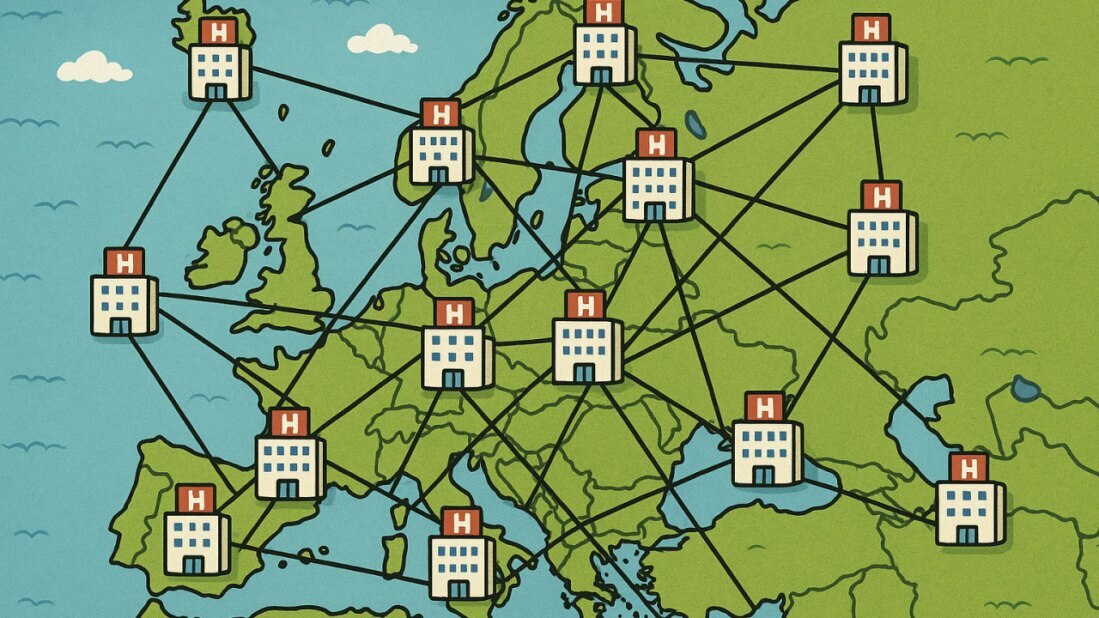
“Another GDPR? Non, seigneur non! Zegt dat gin woar is!”
So... What exactly is EHDS?
Let me guess — your eyes are already glazing over. "Another European regulation?", you mutter, staring into your coffee.
Yes. But this one might actually help.
The European Health Data Space (EHDS) is an EU law that wants to break open the vaults of health data — safely, legally, and with a hint of digital elegance. It's designed to make your health data work for you, for your doctor, and for society.
And unlike GDPR, it’s not just about saying “no.” It’s about making health data flow where it needs to go — under strict controls, of course (this is Europe, after all). #GDPRsBetterLookingCousin
EHDS covers two big domains:
Primary Use: When It’s About You
Primary use = when health data is used directly for your care. You break a leg in Sweden? A shark bites your arm off when surfing in Portugal? In the hospital, they’ll pull up your ePrescriptions from Belgium. Your lab results? Imaging? Vaccination history? Allergies? All shared — securely, and in a format that actually makes sense.
This cross-border magic will be powered by a system called MyHealth@EU, which your Electronic Health Record EHR (that old beast...) will soon have to plug into.

Secondary Use: When It’s for Society
This is the big innovation.
Secondary use means your health data — anonymised or pseudonymised — can be reused for research, AI development, policy-making, innovation, etc.
This twin brother of MyHealth@EU is called HealthData@EU.
Think: helping UZ Leuven study rare diseases, or training an AI model to detect cancer... all without anyone knowing it’s your data.
And the best part? You can opt out. Though if you do, a PhD student somewhere in Ghent will weep silently.
Primary Use = for you | MyHealth@EU
Secondary Use = for society | HealthData@EU
Wait — is this for real?
Yes. EHDS is not just a nice idea. It’s a Regulation, not a Directive.
Translation: It’s directly applicable in all EU countries, including our beloved Kingdom of Belgium. No room for fudge, no “we’ll see about that.”
It entered into force in March 2025 and comes with a carefully cooked phased rollout, just like a good stoofvlees: slow, structured, and with many ingredients.
Phased Implementation: What Happens When?
EHDS will not fall out of the sky overnight. Here’s the European slow-cook timeline:

2025–2026: Mise en place
- EU sets technical standards
- Member States designate: (1) a Digital Health Authority for managing primary use. Belgium’s ready! If you haven’t done so already, log on to https://www.ehealth.fgov.be/ and check out your digital health dossier. (2) at least one Health Data Access Body (HDAB) for managing secondary use. Here as well, Belgium’s ready – see below.
- MyHealth@EU and HealthData@EU infrastructure prepped
2027: Plan de Table
Electronic Health Record (EHR) vendors must comply with:
- Interoperability specs
- Logging & access controls
- CE marking & certification
Start praying to the gods of legacy systems now.
2028–2029: à Table
Hospitals & clinics must allow:
- Patient access to their own data (summary, labs, meds…) via MyHealth@EU. Hurray for https://www.ehealth.fgov.be
- Data sharing across EU via HealthData@EU
Secondary use becomes reality: HDABs start issuing permits to researchers in need of data.
2030–2031: Épiçons un peu!
- Scope expands to discharge reports, genomics, imaging, etc.
- More obligations for vendors and data holders
- Third-country organisations can start applying to participate. Welcome my British and Monegasque friends.
And what about Belgium?
Unlike some EU countries still trying to agree on who brings coffee to the EHDS meetings, Belgium already knows who its Health Data Access Body (HDAB) is going to be:
👉 The Health Data Agency, or simply “HDA”.
This agency will act as Belgium’s central gatekeeper for the secondary use of health data — reviewing requests, managing access, enforcing safeguards, and keeping it all nicely aligned with GDPR and national law.
HDA is already working behind the scenes to make this happen — so expect announcements, platforms, and portals to pop up soon. In a multitude of languages. Off course. This is Belgium.
Who Needs to Do What?
EHDS is not just for EU officials or data nerds in Luxembourg. It affects everyone:
Governments
- Set up national frameworks (✅ Belgium’s already designated HDA)
- Support technical infrastructure (this includes setting up Secure Processing Environments (SPE) where the researchers can actually dig in the data.)
- Enforce citizen rights & ensure compliance
Basically: create the framework in which researchers can access the data to invent some new cool stuff that helps us cure diseases.
Hospitals / Care Providers / Industry: the "Data Holders"
- Give patients real-time digital access to their data
- Share data via MyHealth@EU
- Implement logging, audit trails
- Respect patient opt-out choices
Basically: make data available to researchers to invent some new cool stuff that helps us cure diseases.
EHR Vendors
- Certify systems to new standards
- Plug into EU frameworks
- Ensure data portability & interoperability
- Provide documentation & logs
Basically: make sure the data can be made available to researchers to invent some new cool stuff that helps us cure diseases.
Researchers / Pharma / AI Startups: the "Data Users"
- Apply to Health Data Access Bodies (like HDA) for permission
- Use secure processing environments
- Respect purpose limitations and no re-identification
- Comply with Belgian & EU rules on access, reuse, and reporting
Basically: use the data to invent some new cool stuff that helps us cure diseases.

Patients & Citizens
- Can access their health records anywhere in the EU
- Can opt out of secondary data use
- Will (eventually) be able to manage their health data preferences via a national portal
Basically: sit back and relax while smart people invent some new cool stuff that helps cure diseases.
Final Thoughts — à la Belge
EHDS isn’t just another European regulation to print and ignore. It’s a data revolution in disguise, and Belgium’s got its seat at the table — with HDA ready to lead the charge.
It’s not perfect. There will be hiccups. But it’s a big step towards data solidarity, health innovation, and finally fixing that EHR system that still runs on Windows 98.
So yes, Dummies, we better get ready. Because the data train is leaving the station.
Let me know if you want a talk, a training, or a pint at Dulle Griet to cry about HL7 or FHIR formatting. #FHIROrDie