
The Digital Backbone - South Africa
Connected care needs a
stronger spine.
South African healthcare is changing fast. NHI readiness, POPIA-aligned data governance, workforce pressures, and rising demand are pushing hospitals, funders, laboratories, and public health systems to do more with the systems they already have — and to prepare responsibly for AI.
The organisations moving fastest have stopped chasing isolated projects. They are building a trusted digital backbone: the interoperable data foundation that turns fragmentation into flow, and information into better decisions.
Interoperability, AI readiness,
and resilient care operations
- Secure, POPIA-aligned data exchange across
existing healthcare systems - More complete patient and operational views
for mission-critical workflows - A scalable foundation for AI-enabled
applications and future innovation - NHI readiness through standards-based
interoperability (HL7 FHIR, IHE)
InterSystems is Trusted by
Healthcare
Organisations Worldwide


What a digital backbone enables
These priorities may look different across organisations, but they depend on the same requirement: trusted data moving through a resilient, interoperable architecture.
What is a digital backbone in healthcare?
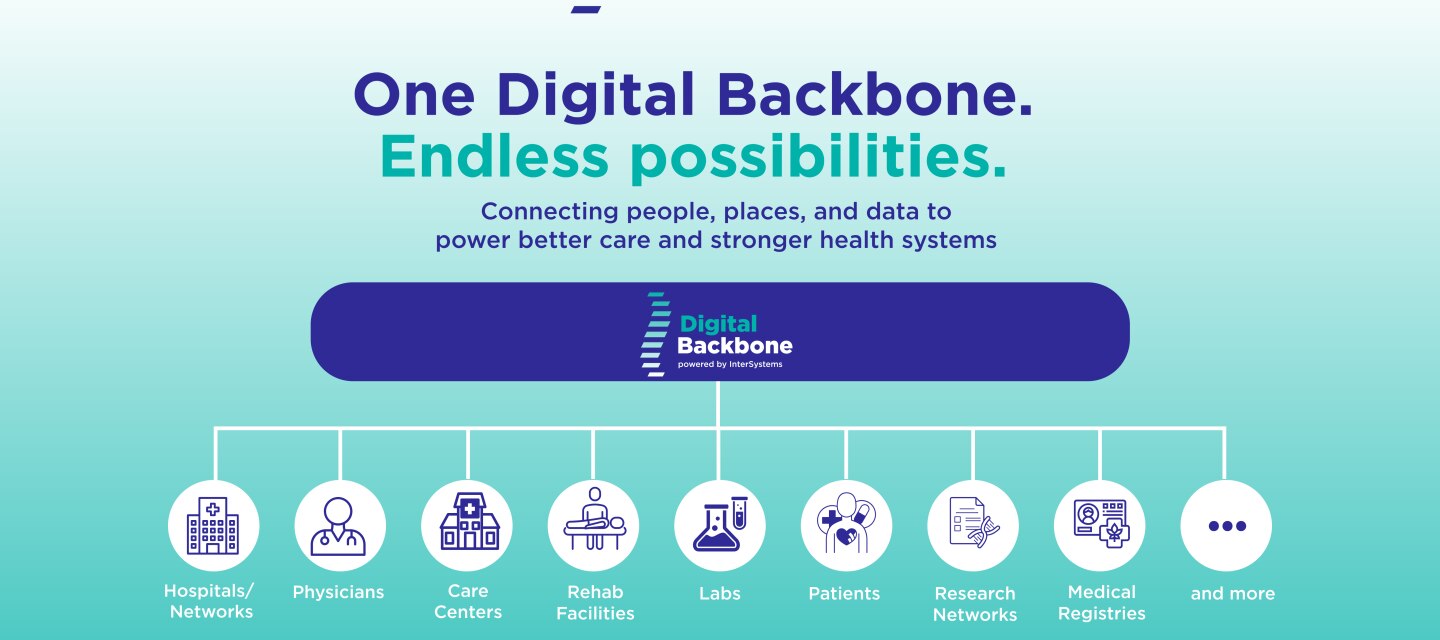
Just as the spine supports and protects the body's movement, a digital backbone is the interoperable data and integration foundation that connects existing healthcare systems, moves information securely, and makes it available where care, operations, and decisions actually happen.
A digital backbone is not another isolated application. It is the architectural discipline that lets hospitals, clinics, laboratories, medical schemes, administrators, and public health systems work together — turning a collection of projects into a reusable, enterprise-grade platform.
For South African healthcare organisations navigating modernisation, the goal is not wholesale replacement. It is seamless integration across the systems already supporting clinical, operational, financial, and administrative work — from provincial hospitals to private groups, from labs to medical schemes.
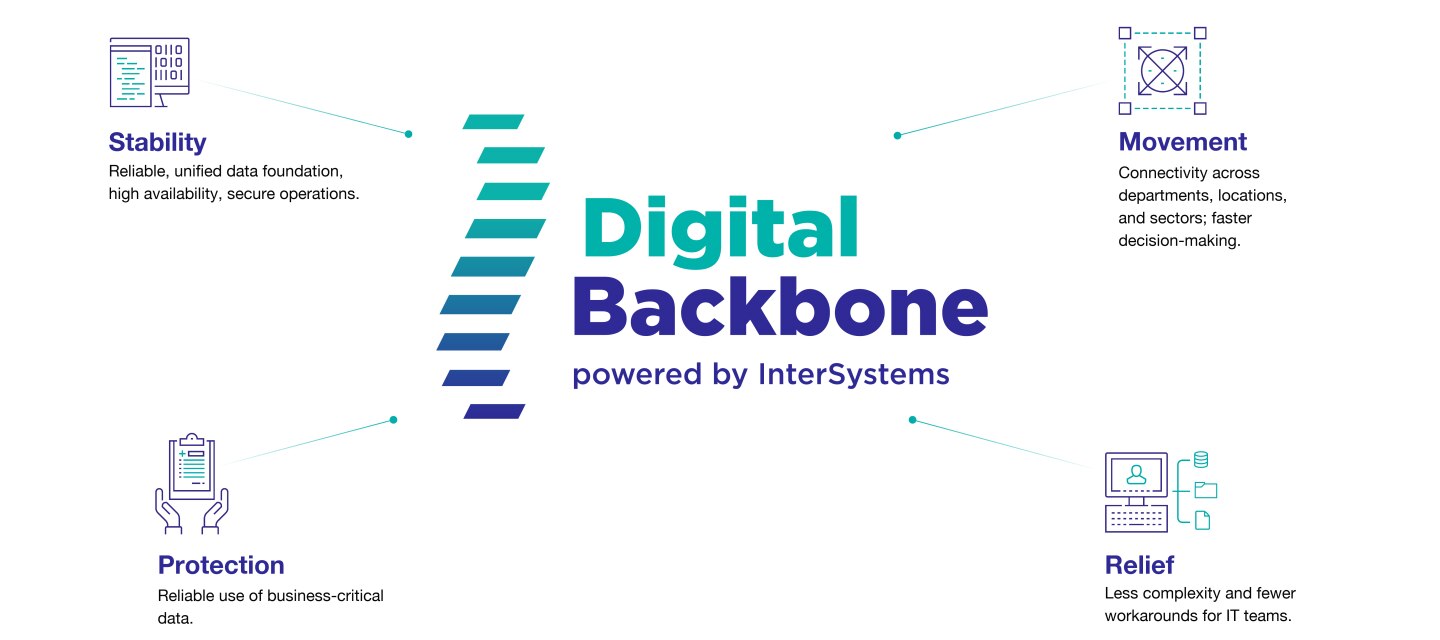
The four qualities of a spine — and of a digital backbone
built to carry the weight of connected care.
Why it matters now — in South Africa
Healthcare organisations already generate enormous volumes of clinical, operational, financial, laboratory, and administrative data. The challenge is not the data itself. It is the fragmentation, the missing standards, and the growing distance between AI ambition and AI reality.
The foundation demanding healthcare environments trust.
Four qualities of a digital backbone
Borrowed from the anatomy of the spine — the qualities that describe what a trusted digital backbone must deliver for healthcare organisations under pressure.
Modernisation should work with your current environment — not against it.

Most healthcare organisations cannot — and should not — replace every system at once. Modernisation must work with the platforms already carrying clinical, operational, and administrative load: hospital information systems, laboratory platforms, radiology, patient portals, mobile apps, analytics tools, and finance systems.
A digital backbone connects these environments through a consistent data layer. It protects existing investments while making trusted information easier to use across departments, facilities, and care networks — including across the public-private divide that defines South African healthcare.
What were once isolated systems become part of a resilient axis. EHRs, laboratories, radiology, nursing, administration, and external applications connect seamlessly. Data flows where it is needed for processes and decisions.
From fragmented point solutions to a coherent, enterprise-grade environment
With the right foundation in place, organisations move from isolated fixes to a shared, scalable platform that supports every downstream use case — today and tomorrow.
- Interoperability across existing HIS, LIS, PACS, ERP, and portals
- Secure, governed, POPIA-aligned data exchange
- More complete patient and operational views
- Reduced reliance on manual workarounds and custom interfaces
- Greater resilience for mission-critical workflows
- A stronger foundation for AI readiness and future innovation
- Standards-based support for NHI readiness (FHIR, HL7, IHE)
- Lower total cost of ownership through fewer moving parts
- Connecting what already exists
What "connected at scale" looks like
Around the world, InterSystems already powers some of the largest connected health environments. The lessons translate directly to South Africa's ambitions.

"The largest health information exchange platform in the United States — a real-time nervous system for patient data across a highly complex, multi-provider environment."
16M
CITIZENS
6000+
LOCATIONS
600+
ORGANISATIONS
7M+
REAL-TIME CLINICAL NOTIFICATIONS
A proven foundation for connected,
interoperable, AI-ready healthcare.
Powered by InterSystems IRIS for Health, HealthShare, and Health Connect — the same platform trusted by leading health systems, information exchanges, and public health authorities worldwide.
InterSystems helps healthcare organisations create the trusted digital backbone needed to connect systems, govern data, support interoperability, and prepare for future healthcare innovation.
Our approach is not to replace everything already in place. It helps healthcare organisations build the foundation that enables existing systems, data, and digital initiatives to work together more effectively, securely, and sustainably.
The result is a proven foundation trusted by demanding healthcare environments, with strong capabilities across data integration, FHIR-enabled interoperability, high-performance processing, embedded AI/ML, and mission-critical reliability — recognised by four 2026 Best in KLAS awards, including #1 rankings in Acute Care EHR and Shared Care Records.
Frequently Asked Questions
Connected care starts
with trusted data.
Connected care, AI readiness, better patient experiences, NHI readiness, and healthcare transformation all depend on trusted data. InterSystems helps South African healthcare organisations build the digital backbone to support what they need today, and what comes next.